Threat to canopy
Gardens losing ‘Green’ purpose amid concretisation
Gardens losing ‘Green’ purpose amid concretisation
| Date :17-Jul-2026 |
By Simran Shrivastava :
Public gardens are meant to be the lungs of a city. But across the city, environmentalists say gardens are losing that purpose as beautification is being equated with concretisation.
Gardens are dominated by paver blocks and concrete and so parks are left with very little green cover despite being designated green spaces. Gardens are being judged by decorative paving, ornamental installations and construction rather than their performance.
Experts argue that the city’s approach is replacing ecology with engineering.
The concern, they say, is this: Excessive concretisation prevents groundwater recharge, intensifies the Urban Heat Island effect, restricts tree roots and reduces habitat for birds, butterflies and insects.
Environmentalist Prachi Mahurkar cited Trimurti Nagar Garden and the newly developed garden near Sonegaon Lake as examples where hardscaping has replaced natural surfaces. She mentioned that lakefront gardens should ideally function as ecological buffers with native vegetation and permeable surfaces rather than becoming ornamental concrete.
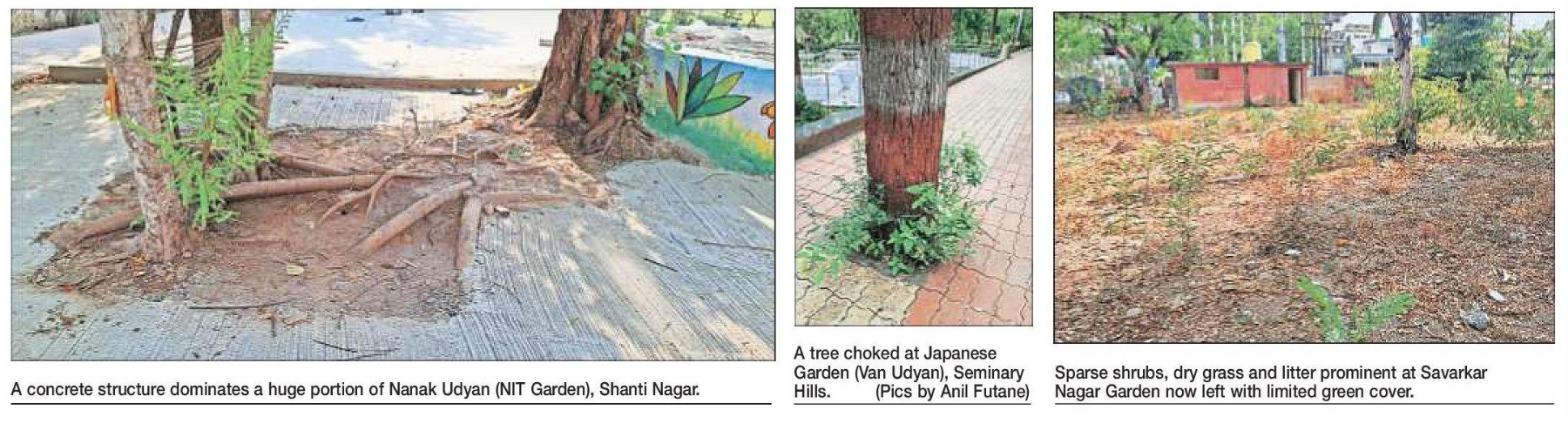
A visit by ‘The Hitavada’ to Nanak Udyan (NIT Garden), Shanti Nagar, further highlighted these. Large stretches of the park have been paved with concrete, leaving only narrow openings around mature tree trunks. In many places, thick roots are showing up above the surface while remaining surrounded by concrete.
Environmentalist Dilip Chinchmalatpure questioned the tendency to concretise public spaces. “Roads have been concretised, footpaths have been concretised, residential premises have been concretised, and now the love for cement is encroaching the gardens.
If rainwater cannot enter the ground, groundwater recharge suffers. Why should gardens also become concrete?” he asked.
Even at Savarkar Nagar Garden one finds very few grown trees despite being designated as a public garden. Large portions consisted of exposed soil, sparse shrubs, dry grass and litter, hence offering very little shade during the day.
On the issue, NMC’s Garden Department officials shared that if some parks where trees remain choked by concrete have been left out, de-choking work would also be carried out there.
However, when asked for data regarding previous de-choking work carried out in gardens in previous years, NMC shared that none as such is maintained.
As the city continues to urbanise, environmentalists have stressed that a successful garden should not be measured by the quantity of concrete laid or decorative structures installed, but quality of life it sustains for trees, biodiversity and the people who seek refuge here.