Don’t judge a product by its cover
Read fine print to decipher ‘healthy’ food claims
Read fine print to decipher ‘healthy’ food claims
| Date :18-Jul-2026 |
By Reema Mewar :
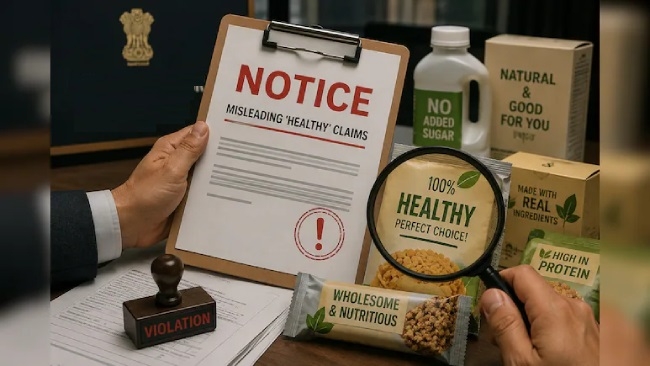
Over the last few years, as more and more people have started transitioning towards healthier food choices, the food industry has evolved to meet these ever-changing demands. However, this ‘evolution’ is largely superficial for the most part, and one aspect where we as consumers are misled the most is packaging and marketing of commercially sold food items.
Take for example, brown bread or multigrain bread. Nearly all popular packaged food companies sell some or the other variant of this, marketing it as a ‘healthier alternative’ to the regular maida bread. “People see the brown-coloured bread, or slices covered with pumpkin seeds or sesame seeds, and immediately assume that this is a healthy alternative which is fine for regular consumption.
However, upon turning the packaging over and reading the labels, the first ingredient one would see glaring back at them is refined wheat flour, or maida,” said Dr Kavita Gupta, a clinical dietitian. “This is also the case for when products are labelled ‘lite’ or ‘natural’ or ‘sugar-free’, so people think they are lesser in calories or healthier, but that is not the case,” she explained. “It is very important that consumers too remain proactive about what they are eating. They should always look at the nutritional information and quality of ingredients before purchasing anything,” said Krishna Jaipurkar, Joint Commissioner (Food), Food and Drug Administration, adding that he strongly believes that home-cooked food is the best and most reliable option.
Dr Pramod Gandhi, an endocrinologist, cautioned, “It is well-known now that sugar, maida, and palm oil are harmful for our health and are linked with a variety of dangerous health conditions like obesity, high blood pressure, or diabetes.
However there are various other chemicals and additives that may be harmful for our health in the long run. It is imperative that we consume these items very mindfully after understanding what goes inside them,” he cautioned. “This includes reading labels, understanding what exactly the food additives labelled under ‘INS’ are, and what effects they can have on our bodies when consumed.”
So if sugar, maida, and palm oil are the red flags, then what are the green flags? Dr Renuka Mainde, a clinical dietitian said, “From an overall perspective, home-made snacks are better because we know the quality of ingredients that go into them. Otherwise, one should opt for items that are low in sodium, low in calories, low in both saturated and unsaturated fats, and also, should not be labelled ‘sugar free’ and contain large amounts of jaggery. People should look for foods with high protein and fibre content. In whatever context, the most important thing is portion control.” As cases of obesity, diabetes, hypertension, and other diseases continue to rise, all three experts collectively placed emphasis on the importance of label literacy, meaning making informed decisions after knowing what exactly one is eating the impact it may have on one’s body and overall health.