Traffic experiment at Agrasen Square raises questions as pedestal returns
| Date :26-Jul-2026 |
Staff Reporter :
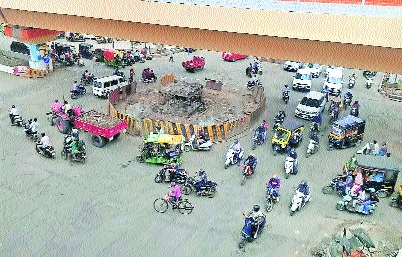
For nearly a month, one of the city’s busiest intersections offered a rare glimpse of how much road space can influence traffic movement. With the statue of Maharaja Agrasen and the central traffic island temporarily removed during construction of the Indora-Dighori Flyover, vehicles moved through Agrasen Square noticeably faster.
Motorists reported shorter queues and smoother passage even during peak evening hours. Now, as the flyover nears completion, work has begun on rebuilding the pedestal to reinstall the statue at its original location.
As the central island returns, commuters fear the improvements witnessed during the past month may soon disappear.
Congestion returns
The change is already becoming visible. The reconstructed island has started reducing the available carriageway and congestion has returned between 5 pm and 7 pm. Motorists are once again waiting through two or even three signal cycles before crossing the junction. The debate, however, is not about the statue.
Earlier known as Fawara Chowk, the intersection derives its present identity from the Maharaja Agrasen statue that stood at its centre for decades.
Most citizens support its reinstatement. The real question is whether the landmark can be preserved without sacrificing road capacity at one of the city’s busiest junctions. Tejinder Singh Renu, a respected city personality, believes better design can achieve both objectives. “The intersection should be designed with the central island having the smallest practical footprint, ensuring that the cultural landmark is preserved without compromising road capacity. The objective should be to maximise the available carriageway while ensuring safe movement of both pedestrians and vehicles,” he said. Lessons from the past
The city itself has faced similar situations before. Statues that once occupied the middle of major intersections, including the Mahatma Gandhi statue at Variety Square and the Rani Lakshmibai statue at Jhansi Rani Square, were shifted to the roadside as traffic volumes increased. That reflected an era when traffic signals became the preferred method of regulating traffic.
Modern roundabouts are making a comeback because they reduce conflict points, improve traffic flow and lower the risk of severe crashes compared with signal-controlled intersections where traffic conditions permit. Nagpur has also adopted this model. The newly developed roundabout at Jadhao Square near Ganeshpeth Bus Stand is the latest example. Urban planners believe intersections should be designed according to present-day traffic demand rather than historical layouts alone. With proper geometry and a compact central island, they say, it is possible to preserve heritage while improving both traffic flow and safety.
Discipline still a challenge
Another persistent problem at Agrasen Square is poor lane discipline. Vehicles approaching from Golibar Square and Mahal frequently enter the junction after the signal turns red, blocking traffic moving on the green signal and creating gridlock.
The past month’s temporary arrangement became an unintended but valuable traffic experiment. It demonstrated how even a small increase in road space can transform traffic movement. As Maharaja Agrasen’s statue returns to its rightful place, the city has an opportunity to prove that heritage and efficient mobility can coexist. Striking that balance will determine whether Agrasen Square remains a landmark or once again becomes a