From coal pits to forests, CIL launches landmark mine restoration initiative
| Date :27-Jul-2026 |
By Ashish Rajput :
IN A first-of-its-kind initiative in India,
scientists have begun ‘Restoring
Forests’ on abandoned opencast coal
mines using a scientific ecological
approach that goes far beyond conventional tree plantation.
Under this special project, instead
of merely increasing green cover, the
project lays emphasis to revive biodiversity, improve soil health and recreate the ecological functions of natural
forests.
The ambitious restoration programme, funded by the Coal India
Limited (CIL), is being implemented
across coal-mining areas operated by
South Eastern Coalfields Limited
(SECL) and Western Coalfields Limited
(WCL) in Madhya Pradesh,
Chhattisgarh and Maharashtra states.
As a matter of fact, these three states
account for 18 of the 39 coal mine sites
selected nationwide for ecological
restoration studies.
According to Dr Avinash Jain,
Scientist-F and Head of the Forest
Ecology & Climate Change Division,
ICFRE-Tropical Forest Research
Institute (TFRI), Jabalpur, the project
has been launched under the direction of Dr Sanjeev Bhatia, National
Project Coordinator of Centre of
Excellence on Sustainable Land
Management (CoE-SLM). He described
it as India’s first techno-scientific ecological restoration programme dedicated to restoring mined landscapes.
Unlike traditional plantation drives,
the project is designed to recreate entire
ecosystems. Scientists have spent nearly two years studying soil characteristics, native vegetation, climatic conditions and biodiversity before preparing restoration plans for individual
sites.
The idea is to restore landscapes
according to their original ecological
conditions rather than planting the
same species everywhere.
So far, 13 mining sites have been
handed over to TFRI for restoration,
with plantation activities already
underway at 10 locations. The programme covers nearly 90 hectares, with
each restoration site spread across
about five hectares.
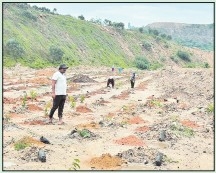
The restoration model combines
native trees, shrubs and grasses to
resemble natural forests. Around 25
saplings and nine shrubs are being
planted in each plantation block, while
species selection varies according to
local topography and agro-climatic
conditions. On steep slopes, bamboo
and other soil-binding species are being
planted to prevent erosion, alongside
rainwater harvesting measures to conserve moisture.
To support the programme, TFRI has
raised around two lakh quality saplings
in its nursery. While each restoration
site is expected to accommodate nearly 12,500 plants, researchers say the success of the project will not be measured by plantation numbers alone.
Instead, they will monitor plant survival, soil improvement, biodiversity
recovery and the gradual return of natural ecological processes.
Scientists believe the restored landscapes could eventually support
wildlife, improve water conservation
and even provide sustainable livelihood opportunities through medicinal plants, agroforestry and silvipastoral systems where suitable.
As India continues to depend on
coal for energy, the project offers a scientific roadmap for balancing resource
extraction with environmental recovery. If successful, it could become a
national model for transforming
degraded mining areas into self-sustaining forest ecosystems.