First rains lay bare civic body’s monsoon preparedness
Date :03-Jul-2026
Staff Reporter :
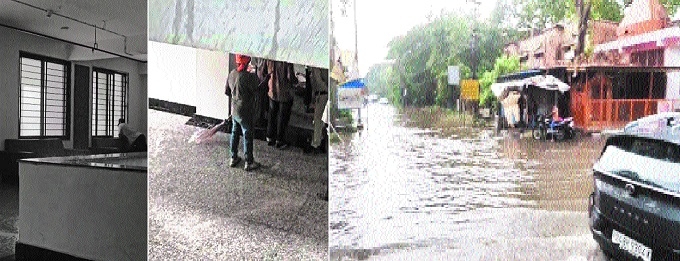
The construction quality of Atal Bhavan, the luxurious and newly-built headquarters of the Bhopal Municipal Corporation (BMC), has been completely exposed during the very first heavy downpour. Inaugurated merely two months ago on May 7 by Chief Minister Mohan Yadav, this eight-story modern edifice was constructed at a massive cost of approximately Rs 72 crore. However, following the initial heavy rains, severe water leakage has commenced from the ceilings and concrete beams in the basement of this highly publicised green building. The most deplorable conditions are observed in areas situated directly beneath the washrooms on the upper floors, where leaking sewage pipelines are causing water to seep through the concrete and drip straight into the parking area below.
The initial monsoon showers have completely washed away the municipal corporation’s claims regarding effective drainage systems. The main roads stretching from Alpana Tiraha, considered the busiest commercial hub of the State capital, through Bharat Talkies Road and Nadra Bus Stand up to Platform Number 6, have been entirely inundated. Despite spending roughly 1.87 crore rupees over the last five years and allocating an additional 45 lakh rupees this year to prevent waterlogging in this specific zone, the results remain an absolute zero. A mere two hours of intense rainfall transforms the entire locality into a stagnant pool for several hours. According to the municipal corporation’s own historical records, 789 drains were officially registered in the city in the year 2005, a number that has shockingly dwindled to just 642 by the year 2021.
Dilapidated roads endanger lakhs of commuters: A vast majority of the approximately 2,550 kilometres of roads falling under the municipal corporation’s jurisdiction are in a highly dilapidated condition.
The service lane of Narmadapuram Road is completely shattered, disrupting the daily commute of nearly 6.30 lakh residents across 38 colonies, including Narayan Nagar, Shri Ram Colony, and Danish Nagar. Similarly, massive potholes have developed on the deteriorating roads of Nai Bahar Sabzi Mandi, Hamidia Road, Ghoda Nakkas, and the Kotwali area, where the accumulation of stagnant dirty water and garbage has escalated the risk of mosquito-borne diseases. No asphalt laying work has been undertaken on the main roads surrounding the Putlighar Bus Stand for the past 16 months, forcing approximately 4 lakh daily commuters to navigate through dust, mud, and potentially fatal accidents.
Drainage network tangled in inter-agency blame game: The primary reason behind the crumbling drainage system in Bhopal is the glaring lack of co-ordination among various government agencies. The Public Works Department, the Public Health Engineering Department, the Municipal Corporation, and the Bhopal Development Authority are turning the general public into pawns in their blame game. Nearly 30 per cent of the drains on the city’s main roads fall under the Public Works Department, yet they conveniently shift the responsibility of cleaning them onto the municipal corporation.
For instance, the entire drainage network from Lalghati to Sehore Naka falls under the jurisdiction of the Public Health Engineering Department, while the municipal corporation washes its hands of cleaning the drains in Arera Colony, Alpana Tiraha, and Jyoti Talkies because they belong to the Public Works Department.
Municipal Commissioner Sanskriti Jain stated that emergency disaster response teams are being promptly dispatched to carry out remedial work wherever complaints of waterlogging are being received. She mentioned that field staff have been directed to immediately remove the silt and garbage that had washed up at the mouths of drains and roads due to the heavy flow of rainwater.