Stormwater drainage, pumping system counter Narendra Nagar RUB problem
| Date :03-Jul-2026 |
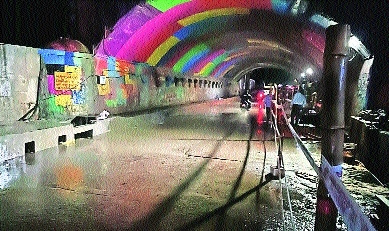
CONTAINED: No water-logging was witnessed at Narendra Nagar RUB during heavy rains on Wednesday night. (Pic by Anil Futane)
Staff Reporter :
For years, the Narendra Nagar Railway Under Bridge (RUB) has been one of Nagpur’s worst monsoon bottlenecks, with even moderate rainfall leading to severe water-logging, traffic disruptions and inconvenience to thousands of commuters. This monsoon, however, the RuB has passed its first major test following installation of an advanced stormwater drainage and pumping system by the Public Works Department (PWD) under a World Bank-funded project.
Despite heavy rainfall on Wednesday, the underpass remained free of water accumulation and vehicular movement continued without interruption. The successful performance of the newly installed system marks a significant improvement over previous years, when the underpass would often have to be closed due to flooding.
The underpass, which had remained closed for more than three months to facilitate construction work, has now been reopened for traffic.
Officials said the project was aimed at providing a permanent engineering solution rather than relying on temporary dewatering measures adopted during every monsoon.
The drainage model was initially developed and tested on a pilot basis near Padole Chowk by the PWD team led by Executive Engineer Krusha Gharde and Deputy Engineer Ashish Kurve.
After delivering encouraging results, the department decided to replicate the system at Narendra Nagar, one of the city’s most flood-prone railway underpasses.
At the heart of the project is a five-metre-deep reinforced concrete sump constructed adjacent to the underpass. The sump functions as a collection chamber where rainwater from the underpass and surrounding localities is channelised before being pumped out.
Installed inside the sump are three high-capacity sludge pumps, each of 40 HP, equipped with automatic sensors that activate the pumps whenever the water level rises beyond a specified limit. Together, the pumps can discharge nearly 1,500 litres of water per second through three 600-mm diameter pipelines, ensuring rapid evacuation of stormwater even during intense rainfall.
A comprehensive drainage network has also been developed around the underpass. Stormwater from nearby residential layouts and adjoining roads is diverted through newly laid drains into four collection chambers constructed on both sides of the underpass. From these chambers, the water flows into the sump through a properly channelised system, preventing water from accumulating on the carriageway.
Unlike conventional pumps, the installed sludge pumps are capable of handling not only rainwater but also silt, mud and other solid particles that are commonly washed into drains during heavy showers.
This significantly reduces the risk of choking and ensures uninterrupted operation of the drainage system during peak monsoon conditions.
Another major component of the project is the construction of a retaining wall along the adjoining nullah. Earlier, the nullah frequently overflowed during heavy rainfall, causing floodwater to backflow into the underpass and aggravating waterlogging. The retaining wall now prevents the nullah from overflowing into the road, while the pumping system simultaneously discharges collected stormwater into the watercourse in a controlled manner.
Officials said the project integrates collection chambers, underground drains, the deep sump, automated pumps and the strengthened nullah protection system into a single stormwater management network.
The coordinated functioning of these components enables quick disposal of rainwater, substantially reducing the possibility of flooding even during high-intensity rainfall.
The successful trial during Wednesday's heavy rains has provided confidence that the Narendra Nagar underpass may finally be free from the chronic flooding that had become synonymous with the location for several years. With traffic moving smoothly and no significant waterlogging reported, the project is being seen as a model for tackling similar flooding problems at other vulnerable railway underpasses and low-lying areas across Nagpur.