‘Hypocrisy biggest challenge for Hindustani music’
| Date :30-Jul-2026 |
By Reema Mewar :
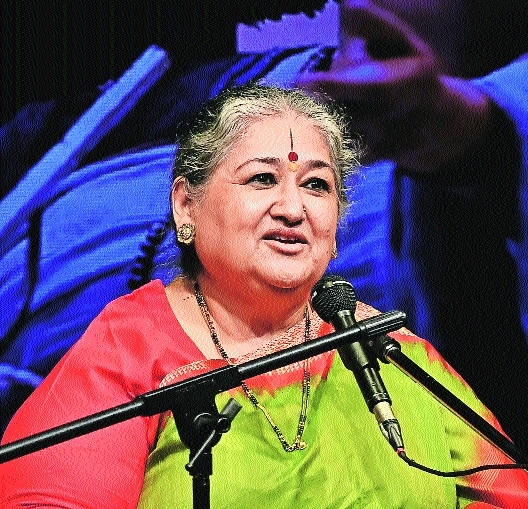
Renowned Classical singer Padma Shri Shubha Mudgal interacted with ‘The Hitavada’ ahead of her performance at Dr Vasantrao Deshpande Smruti Sangeet Samaroh in Nagpur
“There is a famous saying in the Hindi heartland — Raag, rasoi, pagdi kabhi kabhi ban jaaye.”
It was not a quote about music theory or performance technique. It was a proverb.
It refers to three things that can never be guaranteed: a musical performance, a meal in the kitchen and the tying of a turban. All three demand skill. All three require years of practice. Yet none can be taken for granted. For Shubha Mudgal, that uncertainty has never disappeared. Not after decades on stage. Not after years of riyaaz. Not after becoming one of the country’s most celebrated voices in Hindustani classical music.
“For me, the excitement is in this very uncertainty and the humility with which one must approach it. The hope is that the good wishes and blessings of one’s gurus, listeners, and the active support of one’s accompanying artistes will steer me through the performance,” Mudgal said during an interaction with ‘The Hitavada’ ahead of her performance at Dr Vasantrao Deshpande Smruti Sangeet Samaroh in Nagpur.
Experience, she said, has never been a guarantee.
That thought lingered through the rest of the conversation.
Asked about the legacy of Dr Vasantrao Deshpande, Mudgal said it was impossible to reduce his contribution to a single achievement. “His body of work is too vast for that. What continues to inspire me most is his willingness to draw from multiple gharanas and shape those influences into a style that was unmistakably his own.” She pointed out that people often think that classical music, or any classical art form in general, are quite rigid and don’t allow one to borrow from different gharanas. Those who embrace different styles or methods rather than sticking to a single system or rule are frowned upon.
“Dr Deshpande’s journey challenged that assumption. His music demonstrated that tradition could accommodate exploration without losing its foundation.”
The conversation eventually turned to younger audiences — a subject that often invites sweeping declarations about the future of classical music. Mudgal chose caution instead. She said she could not speak on behalf of young students and artistes, but observed that the landscape they inhabit today is very different from the one she entered into years ago. Knowledge that once remained within the walls of the
guru-shishya tradition is now available through recordings, archives and digital platforms. Performances that earlier could only be experienced once, in person, can now be watched repeatedly. Young learners increasingly turn to online resources, including YouTube, to supplement their training. This is not a replacement for the guru-shishya parampara and institutional education, she said,
maintaining that these structures continue to hold immense value.
“Digital access has expanded possibilities, but it has not erased the importance of the teacher.”
Perhaps that openness to change without abandoning the old also explains how she looks at Hindustani classical music itself.
Music, she said, has always possessed a universal appeal. Hindustani classical music, in particular, occupies a distinctive place because it is ‘a non-representational system’ that allows both the performer and the listener to arrive at their own interpretations and ways of communicating. There is no single prescribed meaning waiting to be decoded. The same raga may evoke different emotions in different listeners. The same performance may unfold differently from one evening to the next. That freedom, Mudgal said, is one of the key reasons the music
continues to resonate across generations and across continents.
She was equally quick to acknowledge that the music’s continued
relevance cannot be credited to the art form alone. Behind it, she noted, stand generations of musicians, teachers, organisers and institutions that have worked consistently to keep it accessible.
When asked what she would tell someone in his/her late teens or early twenties who had never attended a Hindustani classical concert, her answer was striking in its simplicity. She would not ask them to first understand ragas or learn the grammar of the music. “Just come with an open mind and heart, free of all preconceived notions about the music that you might have encountered earlier, experience the
performance and arrive at your own conclusions,” she said.
The advice echoed her earlier observation about interpretation. Listening, in her view, does not begin with certainty. It begins with openness.
For those hoping to pursue Hindustani classical music professionally, Mudgal offered a different counsel.
“Talent and hard work are only the starting point. One must have curiosity — not only about Hindustani music but about other musical traditions as well. One must adapt to changing technologies and presentation formats,” she said, underlining the need for resilience.
Then came a distinction that perhaps matters even more in a profession increasingly shaped by market forces.
While artistes must remain adaptable, she said, they also need ‘strength of conviction’. It is important, she observed, for musicians to understand what gives them satisfaction in their art so that they are not pushed, willingly or otherwise, into following market trends that do not reflect their
artistic instincts.
The conversation moved from the music itself to the realities of sustaining a life within it. “The biggest challenge for Hindustani music today is the general hypocrisy with which it is treated,” she said. “The contradiction is difficult to ignore. On one hand, Hindustani classical music is repeatedly celebrated as an integral part of India’s cultural heritage and sanskriti. On the other hand, many of the artistes who dedicate their lives to it continue to struggle to earn a respectable livelihood through the art alone,” she remarked,
adding that they are often not treated on par with artistes representing popular mainstream music, in terms of fees and other aspects.
“The success of a handful of celebrated performers doesn’t reflect the condition of the larger fraternity. For decades, many musicians have had to depend on parallel professions while pursuing Hindustani classical music alongside them.
What the field requires is not occasional recognition but a fair
system that allows artistes to build sustainable careers.”
About relationship between literature and music,
Mudgal said she enjoyed understanding the sahitya she performed. “A deeper literary understanding can enrich interpretation, though it is no universal rule. I imagine it would be helpful for everyone to be able to understand the literature they are presenting,” she said, adding, “but I guess this is a matter of choice and personal interest.”
Today, she observed, listeners can access music from almost any part of the world. Yet discovery, she argued, has become a different challenge altogether.
Platforms that initially promised equal opportunity are increasingly influenced by those who can afford visibility, advertising and promotional space.
“What can become of a young musician with exceptional talent but little money to compete for attention?” she wondered.
The question lingered long after the conversation ended. If access to music has never been greater, but discovery is increasingly determined by visibility, who gets heard — and how many voices are we still missing?
n