‘Why must we stand in queues everywhere?’Farmers demand 100% moong procurement, following which MP Governmenthas taken major decisions on moong procurement and fertiliser distribution
Date :30-Jul-2026
Staff Reporter :
DEMONSTRATINGfarmers on
the third day of protests in the
State capital raised a fundamental question against administrative systems: why must
farmers be forced to wait in
queues at every single step of
agriculture? First standing in
lines for fertilisers, then in
queues at fuel stations to run
harvesting equipment, and
finally outside procurement
centres and mandis to sell their
yield.
Speaking from the protest
site, several farmers like
Narendra Pawar from Sehore,
Rambhoresh Mundel and
Lakhan Singh Tomar from
Harda, Dharmendra Patel from
along with Siddharth
Raghuvanshi, Deepak Jat, and
Yashwant Gaur from
Narmadapuram, and Mekush
from Itarsi, voiced their primary
demands: 100% Government
procurement of moong crop
and the immediate scrapping
of the e-token system.
Flawed e-token system &
technical barriers
Farmers highlighted that a
majority of cultivators are not
educated enough or equipped
with smartphones to handle
technical digital processes. They
stressed that the necessary network infrastructure to run such
a digital system is not available
in rural areas.
Calling the e-token mechanism deeply flawed, one of the
farmer from Hoshangabad
shared that when he applied
online for 5 bags of subsidised
urea, the system allotted him a
procurement centre in Gwalior,
hundreds of kilometres away,
making it entirely unfeasible to
obtain. Farmers stated that
instead of delivering convenience or service, the e-token
system is failing on the ground.
100% moong procurement
and direct subsidy transfer
On crop procurement, farmers asserted that 100%
Government purchase of
moong is essential because private mandis are not even paying the basic cost of production.
Many farmers shared their
ordeal and said that they have
daughters marry, children
whose fee needs to be paid and
also need to bear the cost of
production, how are they supposed to bear all the expenses
if the government remains
ardent to procure only 25 per
cent of their total produced
moong and private mandis pay
half price.
Addressing the issue of usage
of harmful agricultural chemicals, farmers said, why not put
a total ban on Paraquat and other deadly fertilisers at the market level. They questioned why
the Government allows such
chemicals to be sold openly in
the market, but later uses their
application as a reason to reject
harvested crops at procurement
centres.
Regarding agricultural inputs,
farmers raised the issue of fertiliser subsidies. They demanded that fertiliser subsidies
should be paid directly to farmers rather than being transferred
to fertiliser manufacturing
multinational corporations.
Farmers urged the government
to sell fertilisers at their original cost and reimburse the subsidy directly to the farmers, asking why they are made to stand
in queues and many times
return empty hands from such
centres while MNCs receive the
funds.
Day 3
Escalation:
Barricades
breached,
Gen-Z joins
protests
T h e
input from
the ground
shows that
the protest
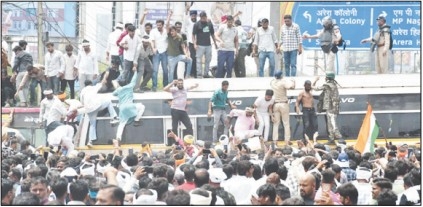
escalated significantly on
Wednesday afternoon.
At 1:30
pm, a large group of farmers,
youth, and supporting Gen-Z
members advanced toward
police barricading near RRL
Naka on Veer Savarkar Bridge.
Protesters attempted to remove
iron barricades, climbed onto
police buses, and engaged in
pushing and scuffling with
police personnel, resulting in
injuries to several officers.
By 5 pm, protesters broke
through multi-layered barricades and moved via Board
Office toward Banganga and
the Chief Minister’s residence.
Police deployed a six-tier security set-up using trucks, buses, and iron barricades to stop
the march.
‘Dal-Baati-Chokha’cooking
on roads and administrative
response: To mark their protest
against inflation and crop pricing, several farmers removed
their shirts. Demonstrators
stayed on the road overnight,
lighting wood fires to cook DalBaati-Chokha directly on the
asphalt and dining together.
Farmer leader Rakesh Dhakad
affirmed that the movement
will continue peacefully until
their demands are met. The
protest disrupted local normal
life, causing major traffic jams
along Hoshangabad Road and
MP Nagar. Office-goers had to
take long detours or park their
vehicles to walk due to limited fuel. The district administration declared a holiday for
all public and private schools
along Narmadapuram Road.
Police Commissioner Sanjay
Kumar stated that over 1,000
police personnel have been
deployed to maintain law and
order and ensure minimal public inconvenience, while continuous discussions are ongoing with farmer leaders to keep
the protest peaceful.