HISTORIC MOMENT, President honours Bastar’s Manjhis, Chalkis
| Date :31-Jul-2026 |
RAIPUR :
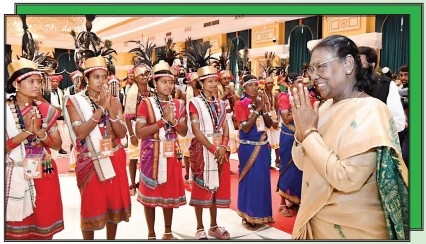
A HISTORIC chapter was written at Rashtrapati Bhavan on
Wednesday as the rich tribal
heritage, traditions and vibrant
attire of Bastar were showcased
there for the first time. President
Droupadi Murmu warmly
received the 209-member delegation from Chhattisgarh, led
by Chief Minister Vishnu Deo
Sai, and personally served lunch
to the guests.
A special luncheon was hosted at the Rashtrapati Bhavan in
honour of the winners of Bastar
Pandum 2026, representatives
of the traditional tribal leadership system, Padma Shri
awardees, public representatives and senior officials. On the
occasion, Chief Minister Sai presented the President with a 300-
year-old tribal artwork, ‘JhitkuMitki’, from Bastar, which she
deeply appreciated for its cultural significance.
During an informal interaction, President Murmu enquired
about Bastar’s tribal traditions,
folk arts, customary governance
system and the experience of
organising Bastar Pandum. She
praised the artists and traditional representatives for preserving the region’s cultural heritage and also expressed her
desire to attend Bastar Dussehra
and Bastar Pandum in the
future.
Responding to Chief Minister
Sai’s invitation, the President
said she would certainly visit
Bastar in the future. “Bastar
Dussehra touches my heart,”
she said, adding that she has
always felt a deep emotional
connection with the festival,
especially in reference to the
wooden idol of Lord Jagannath
and the unique traditions associated with it. She also said that
the Manjhi community is like
family to her, noting that her
father was also a Manjhi.
In her address, President
Murmu described Bastar
Pandum as a vibrant celebration of Chhattisgarh’s tribal traditions, folk arts and cultural
heritage. She said the event has
played a significant role in establishing Bastar’s true identity at
the national and international
levels. She added that such initiatives help reconnect young
people with their traditions and
customs while also promoting
tourism and generating employment opportunities. She further
said that with government initiatives and active public participation, Bastar is moving
towards a new era of peace,
development and prosperity.
Commending the expansion of
education, roads, electricity,
drinking water and other basic
infrastructure in the region, she
said Bastar’s transformation is
a matter of pride for the entire
country.
The President also praised the
important social and cultural
role of the Manjhi and Chalki
communities, describing them
as an effective bridge between
society and the administration
while safeguarding Bastar’s traditions and cultural values.
Union Home and
Cooperation Minister Amit Shah
said he had visited Rashtrapati
Bhavan many times before, but
this was the first time he had
seen such a large delegation
dressed in Bastar’s traditional
tribal attire at the Presidential
residence, calling it a moment
of immense pride.
Chief Minister Vishnu Deo Sai
said the delegation’s meeting
with the President was a matter of great honour for
Chhattisgarh, especially for the
Bastar region. He said the occasion provided a historic opportunity to present Bastar’s rich
tribal traditions, culture and way
of life before the President.
The Chief Minister noted that
Bastar is now emerging with a
new identity of peace,
development and cultural renaissance, and that initiatives
such as Bastar Pandum have brought national recognition
to the region’s tribal heritage.
During their visit, members of the delegation also toured
Rashtrapati Bhavan and gained valuable insight into India’s
democratic and constitutional heritage.
Among those accompanying the Chief Minister were
Principal Secretary Subodh Kumar Singh, Secretary Rahul
Bhagat, Special Secretary and Commissioner, Public
Relations Rajat Bansal, Culture Secretary Dr S Bharathidasan,
Bastar Divisional Commissioner Doman Singh, Director of
Culture and Official Language Sanjay Kannauje, along with
several senior officials.