State’s PROCUREMENT CAP leaves farmers unimpresseddespite relief on e-tokens; protesters demand higher cap
| Date :31-Jul-2026 |
Staff Reporter :
WHILE the Madhya Pradesh
Government’s decision to put
the contentious e-token system
on hold has brought immediate
relief to thousands of farmers, but
its updated procurement strategy for moong (green gram) has
failed to satisfy the farming community. Dissatisfaction is brewing across key agricultural belts
as farmer unions argue that the
newly capped limit of 60% of
total produce which is estimated to be three quintals per acre
falls drastically short of actual
yield, leaving them exposed to
severe market losses. The State
Government’s package of measures, which includes suspending
the e-token mechanism due to
frequent server crashes, extending slot booking deadlines, and
constituting a high-level committee under the Agricultural
Production Commissioner to
oversee distribution, was intended to defuse mounting protests.
However, ground responses indicate that the concessions have
only partially addressed core
grievances.
RELIEF ON E-TOKENS
WELCOMED, BUT MOONG
CAPPING DENOUNCED AS
INSUFFICIENT: Protest leaders
and farmers who marched to the
state capital have voiced mixed
reactions. Sunil Singh Rajput, a
farmer leader from Harda who
led a foot-march (paya-yatra) to
Bhopal, welcomed the suspension of the e-token distribution
system and the extension of procurement dates, noting that server glitches had previously paralysed registration.
However, Rajput emphasised
that raising the moong procurement limit to three quintals per
acre falls far short of expectations.
“While moving from one quintal to three quintals is a step forward, farmers are demanding a
minimum procurement limit of
five quintals per farmer so that
growers can secure fair returns,”
Rajput stated.
Other voices from the ground
expressed stronger resentment.
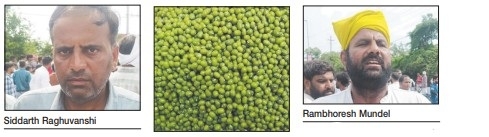
Rambhoresh Mundel, another
farmer from Harda, pointed out
that in high-yield districts like
Harda, average moong production ranges between 6 to 10 quintals per acre. “Procuring just three
quintals or 60% means almost
nothing to us,” Mundel said. “We
are forced to sell the surplus in
local mandis at a loss of nearly
Rs 2,500 per quintal, making it
impossible to recover basic production costs. Even the extended deadlines—August 10 for slot
booking and August 20 for procurement—are inadequate for
ground realities.”
TECHNICAL DISCREPANCIES
AND WIDESPREAD
DISCONTENT
Adding to the frustration are
computational discrepancies in
the state’s procurement formula. According to Siddhart
Raghuvanshi from
Narmadapuram, another affected farmer, technical calculations
used by the administration mean
that farmers are effectively
allowed to sell only around 2
quintals and 82 kilograms per
acre, rather than the promised 3
quintals. “Even within this
reduced limit, we cannot actually sell the full 2 quintals and 82
kilograms,” Raghuvanshi
explained. “Since procurement
centres strictly purchase in standardised 50-kg bags, the remaining 32 kilograms are left behind
and refused at the centres.”
Raghuvanshi noted that
despite agreements reached
between government representatives and 13 farmer organisation leaders, nearly 80 percent
of working farmers remain
unhappy. Persistent technical
glitches during slot booking continue to hinder operations,
prompting growers to warn that
the underlying struggle for complete crop coverage and fair pricing is far from over.