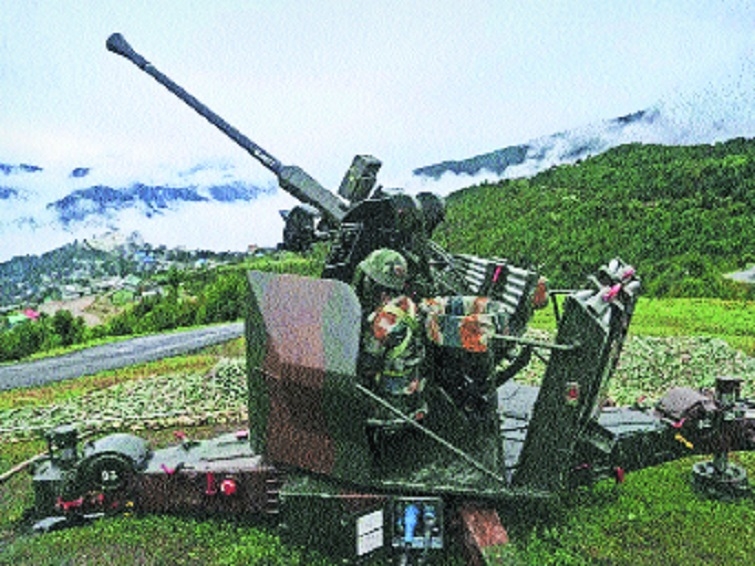
Trusted old L-70 Anti-Aircraft Gun set to take on new-age threats
| Date :04-Jul-2026 |
By Ashish Rajput
Jabalpur,
- GCF will be enhancing it’s capability to detect, track and destroy enemy drones as it has already proved its mettle in Operation Sindoor
- The 40mm gun from the 60’s is no more an ageing anti-aircraft gun but a state of the art anti-drone weapon
- The detection ability throught computer-based fire control systems will further be modernised
In response to the evolving nature of modern warfare and the growing threat posed by unmanned aerial vehicles (UAVs), the Gun Carriage Factory (GCF), Jabalpur, has launched a major upgrade programme for the 40 mm L-70 Anti-Aircraft Gun. The project aims to significantly enhance the weapon’s capability to detect, track and destroy drones and other low-flying aerial threats, building on operational lessons learned during Operation Sindoor.
Confirming the development while talking to ‘The Hitavada’, Rahul Choudhary, General Manager and Public Relations Officer, Gun Carriage Factory, said the project has been taken up as an R&D initiative to make the L-70 suitable for contemporary battlefield requirements.
“The gun will undergo technological upgrades in line with modern warfare. The tracking and fire-control systems will be significantly improved and two prototypes will be developed under this project,” he said.
The L-70 gun, which has been a reliable component of India’s air defence network since the 1960s, has undergone multiple upgrades over the decades. While its internal ballistics have remained unchanged since its original induction, the weapon received major technological enhancements between 2000 and 2020, including the integration of electronic and computer-based fire control systems and the replacement of hydraulic mechanisms with electric drive systems. Another batch of guns was also upgraded in collaboration with Bharat Electronics Limited (BEL).
GM, Choudhary added that the latest modernisation programme will focus on improving the gun’s software and fire-control algorithms to counter the rapidly changing drone threat. The factory’s Research and Development (R&D) division has already begun work on the project and plans to develop two advanced prototypes. The upgraded L-70 will feature enhanced tracking and engagement capabilities for both large and small aerial targets. Larger drones will be tracked through radar integration, while smaller UAVs and low-signature flying objects will be detected using an Electro-Optical Fire Control System (EOFCS). The upgraded software will enable the weapon to automatically identify different categories of aerial targets and generate suitable fire-control solutions.
The L-70 has an effective engagement range of over 12 kilometres and is capable of firing up to 600 rounds per minute, making it one of the Indian Army’s most dependable medium-calibre air defence guns. Existing features already include a ballistic computer system, automatic video tracking, optronic pedestal sighting system, man-machine interface, compatibility with Flycatcher and Reporter radars, independent line-of-sight operation for gun and optronic systems, laser range finder, thermal imager, and an integrated fire-control system with daylight camera.
Officials said that while many of these capabilities already exist, the current upgrade will primarily involve changes to the computer programming and target engagement logic to address emerging drone warfare requirements.
At present, GCF is no longer manufacturing new L-70 guns but continues to undertake overhaul and life-extension of the Army’s existing fleet. Earlier, the factory had also developed a prototype Twin Gun System, although it did not enter production.