Beyond Textbooks Shrinking spaces for leisure reading
| Date :05-Jul-2026 |
By Reema Mewar ;
Rows of students bent over textbooks and competitive examination guides have become a familiar sight in many libraries and reading rooms across Nagpur. While these spaces continue to serve an important educational purpose, readers and library owners say another aspect of library culture has steadily faded over the years -- reading for pleasure.
Several library owners believe that the habit of reading for leisure has declined significantly, particularly among adults. One library owner, who previously maintained a large collection of fiction, self-help, business management and non-fiction books, said that the demand for books had gradually disappeared. With very few readers borrowing books, the library eventually removed its collection and transformed itself into a reading room catering primarily to students.
According to him, reading was once considered one of the most common hobbies. People visited libraries to discover novels, biographies, essays and general-interest books. Today, however, most visitors seek quiet spaces to study rather than books to borrow.
This transformation is visible in several parts of the city, where libraries have increasingly become reading rooms or study centres. The change reflects not only shifting priorities but also changing lifestyles, increased screen usage and growing academic pressures.
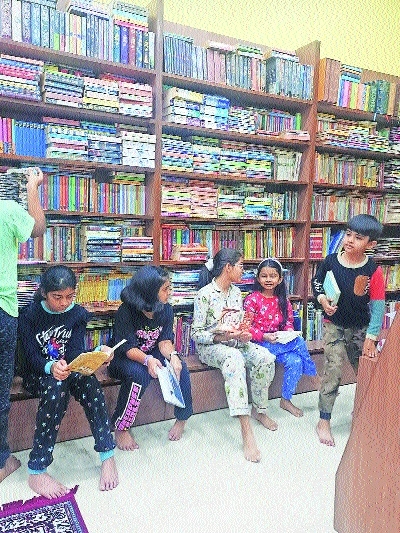
Rashmi Sathe, who has been running a library in Laxmi Nagar for the past 12 years, believes that children continue to read enthusiastically when they are given access to good books and a diverse collection. Her library currently has approximately 350 to 400 subscribers, with membership numbers rising during school vacations. She believes that the discussion should not revolve around fiction versus non-fiction. Instead, children should be encouraged to explore a variety of books. Her library follows a simple rule: if a child borrows three books, one of them must be a non-fiction title of the child's own choice.
She says that children often respond enthusiastically to books on subjects such as dinosaurs, space, animals and science. According to her, young readers absorb information quickly when it is presented in an engaging manner.
The library also houses encyclopedias, magazines, children's newspapers, biographies and autobiographies alongside fiction.
For Sathe, the quality and variety of books are equally important. She argues that children lose interest when they are repeatedly exposed to the same kinds of books or popular series. A carefully curated collection helps them discover new subjects and genres, encouraging curiosity and long-term reading habits.
For many young adults and college students, however, access to leisure reading remains a challenge.
A student from Goa studying in Nagpur said that many books available in institutional libraries are either academic in nature or written in languages that may not be accessible to all students. As someone who does not read Marathi fluently, she often finds it difficult to understand some of the available material. She pointed out that after spending long hours studying and dealing with academic work, students often seek reading that allows them to relax rather than continue consuming information. Fiction, according to her, offers a different kind of engagement, but affordable access to such books remains limited.
The preference for physical books continues despite the availability of digital alternatives. Several readers observed that reading serves as a break from screens, particularly at a time when education, work and entertainment increasingly take place on mobile phones and laptops. While e-books and digital platforms offer convenience, many readers still prefer the experience of holding a physical book.
Ruchi Sharma, an avid reader, believes that libraries can play a significant role in building reading habits within a city. According to her, reading is increasingly becoming limited to people who already own books or can regularly afford to purchase them. She said that introducing children to books at an early age is essential and that access to a variety of reading material allows them to discover their own interests. Ruchi, whose child is also an enthusiastic reader, said that even she sometimes struggles to find suitable books.
The issue is not necessarily the absence of books alone but the shrinking public spaces dedicated to leisure reading. While academic books, competitive examination guides, self-help titles and professional literature continue to serve important purposes, readers and librarians argue that reading should not become entirely utilitarian.
Libraries have traditionally functioned as spaces where people could read without examinations, deadlines or professional obligations. They offered opportunities to explore literature, discover new ideas and cultivate interests beyond academic requirements. The future of libraries may not depend solely on the number of books they contain, but on whether they continue to offer spaces where people can read simply because they enjoy it.n