‘Behind every uniform is a family’Kin of Delhi cops injured during CJP protest seek Parlt’s attention
| Date :01-Aug-2026 |
NEW DELHI :
DISCUSS our trauma in
Parliament too, the families of
four Delhi Police personnel
injured in the July 20 CJP-led
march to Parliament said on
Friday while stressing that the discourse so far has largely centred
on allegations of police excesses. Seeking to tell “their side” of
the violence that broke out during the ‘Sansad Chalo’ march,
they pressed for a discussion in
Parliament on the injuries suffered by policemen on duty and
the trauma endured by their families, saying the conversation so
far had focused mainly on
charges against the force.
Addressing a press conference
at the Constitution Club of India,
the wife of an ACP, the wife of an
ASI, and the children of two
injured police officers recounted the hours they spent waiting
for phone calls from hospitals,
seeing bloodied family members
return home and, later, watching social media narratives that
they felt overlooked the injuries
sustained by the police personnel. Recalling the night her husband returned home injured,
Upneet Kaur, the wife of an ACP,
described the experience as
“traumatic” for her and their twoyear-old daughter.
She claimed that police repeatedly appealed to the crowd to
remain peaceful before bottles,
stones, slippers and other objects
were hurled at them.
“Behind every uniform is not
only a police officer; there is also
a wife, children, parents and an
entire family.
We want people to
understand that,” she said,
adding that the families had
come together to share what
they had gone through after
the violence.
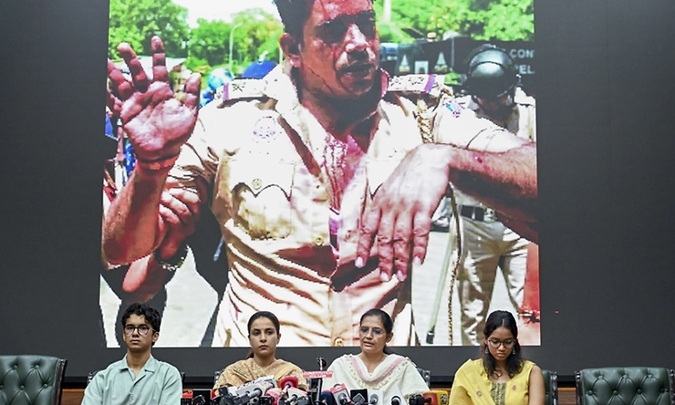
Behind her, a slideshow displayed photographs of bleeding police personnel alongside
figures that, the families
claimed, reflected the scale of
the violence.
The presentation claimed
that more than 250 police personnel were injured in the violence, while over 110 barricades, 300 body protectors, 350
helmets, 20 loudhailers, 10
hand-held metal detectors and
one X-ray baggage scanner
were damaged, with more than
25 government vehicles and
private property vandalised.
Seema, whose husband
joined Delhi Police as a constable 33 years ago and now
serves as an ASI, said that
around 11 am on July 20, her
husband told her over the
phone that the crowd was large,
and the protesters were preparing to march towards
Parliament. Hours later, she got
another call telling her that her
husband was being treated at
the LNJP Hospital.
“When I spoke to him, he
told me that some anti-social
elements in the crowd attacked
policemen with stones, flower
pots, slippers and shoes. After
that, his phone battery died,
and I was terrified,” Seema said.
Her husband returned home
around 11 pm with his protective helmet broken, she said.
“Had another stone struck his
head after the helmet broke, he
might not have survived. But
for days, only one narrative has
been discussed that police used
brutality against students. That
is only one side. We want what
happened to police personnel
and their families also to be
discussed in Parliament,” she
said.