Gold smuggling explodes Post duty hike 150 kg seized since May 13
| Date :10-Aug-2026 |

By Dheeraj Fartode :
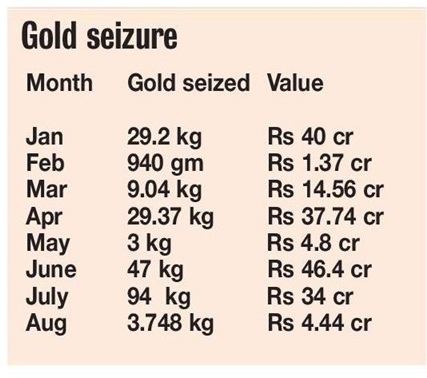
GOLD smuggling has risen sharply after the customs duty on gold was increased from 6 per cent
to 15 per cent on May 13. More than 150 kg of
smuggled gold was seized across India in just three
months after the hike. In comparison, around 70
kg was seized in the first five months of 2026,
according to enforcement data. The sharp rise has
given a fresh push to the illegal gold trade. Smugglers
now find it more profitable to bring gold into India
without paying customs duty.
The new duty includes 10 per cent Basic Customs
Duty and 5 per cent Agriculture Infrastructure and
Development Cess (AIDC). The Government
increased the duty to discourage gold imports, save
foreign exchange and support the rupee. But the
higher duty has also made illegal imports more
attractive. DRI officials said there is a clear pattern. When the customs duty is around 9 per cent
or below, gold smuggling remains largely under
control. Once it rises to 15 per cent, smugglers
become more active.
They can bring gold into the
country without paying the duty and still sell it at
a price lower than legally imported gold.
The figures show the sudden change. Only five
gold-smuggling cases were detected across the
country during the first five months of 2026. After
the duty hike, 11 cases were detected in just three
months. The quantity of gold seized also jumped
sharply. Around 70 kg was seized in the first five
months. More than 150 kg was seized in the next
three months. This means enforcement agencies
seized nearly twice as much gold in three months
as they did in the previous five months. Officials,
however, believe the seizures are only the tip of
the iceberg. A much larger quantity could be moving through the illegal network. Recent DRI and
Customs operations across the India, including Nagpur have exposed the scale of the network.
On
August 4, the DRI seized around seized 2.165 kg
of foreign-origin gold from a person at Nagpur
railway statoin. Investigators found that the carrier had collected the gold near the Bangladesh border. He was then taking it near Mumbai.
Bangladesh has emerged as an important transit
route for the smuggling network. In another case,
a passenger travelling on the Brahmaputra Mail
was caught with around 5 kg of foreign-origin gold.
It was hidden in a waist belt and handbag. The passenger told investigators that the gold had entered
India through Bangladesh.
Sources informed that the network is carefully divided. A carrier may be given the gold and
a train ticket. He may not even
know the final destination.
During the journey, the operator stays in touch with the
carrier over the phone. When
the train approaches a particular station, the operator asks
the carrier to get down. Another
person then takes charge of
the gold. This makes it difficult
for investigators to trace the
entire network by catching one
carrier. Gold is being moved
through airports, railway stations, vehicles and courier consignments.
DRI and Customs
teams have found gold hidden
in aircraft lavatory panels, vehicle cavities, specially made
utensils and luggage frames. In
some cases, carriers have also
concealed gold on or inside
their bodies. The routes are not
limited to Bangladesh, said the
officials.
The DRI seized 4.6 kg of gold
at Kolkata Railway Station in
July. The investigation found
that it had entered India
through Myanmar. In June, 11.6
kg of gold linked to Thailand
was intercepted at Kolkata
Airport. Another 12 kg was
recovered from a courier consignment originating in
Thailand and intercepted in
Delhi. The changing methods
show how organised the smuggling network has become. It
is no longer just about a passenger hiding gold in his luggage.
Syndicates are using multiple carriers, transit points,
handlers and recipients, the
official explained.
In some cases, airport staff
have also been found helping
smugglers remove concealed
gold. For enforcement agencies, the biggest concern is
what they cannot see.
The seized gold may represent only a small part of the
actual illegal trade. The duty
hike was aimed at discouraging gold imports. But the sharp
rise in seizures shows that it
may also have created a bigger incentive for smugglers to
bring gold into India through
illegal channels. DRI officials
urged citizens to share information about gold smuggling
with their office.