Rare Takshak snakes stillfound in Bailadila hills
| Date :10-Aug-2026 |
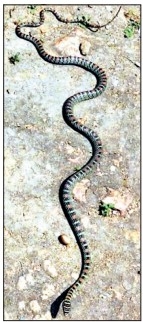
JAGDALPUR :
BASTAR’s forests are home to
several rare species of wildlife,
including the Takshak snake, a
species associated with ancient
Hindu mythology.
The snake is still found in the
Bailadila hills of Dantewada district and has also reportedly been
sighted in the Tirathgarh waterfall area near Jagdalpur.
As per experts, Takshak is popularly known as a ‘gliding snake’
because of its remarkable ability to move through the air.
According to HKS Gajendra, a
former Biology lecturer at Arvind
College, Kirandul, the snake can
glide through the air for a distance of around 50 to 60 feet.
Gajendra is credited with documenting the species in the
region. He said the Takshak is frequently sighted in the
Bailadila hills, where the terrain and habitat are favourable
for the species.
Scientifically known as Chrysopelea ornata, the Takshak
belongs to the group of gliding snakes. It is neither considered highly venomous nor completely non-venomous.
Herpetologists broadly classify snakes as highly venomous, moderately venomous and non-venomous.
The Takshak is placed in the moderately venomous category.
Its venom can cause a mild numbing or sedative
effect in humans but is generally not considered fatal. It
is more effective against small animals such as squirrels
and is used by the snake to subdue its prey.
The snake is able to glide by flattening and curving its
body into an ‘S’ shape while moving through the air. The
species is generally associated with relatively cool and
dry habitats.
The Takshak Nag also finds mention in the Shrimad
Bhagwat Mahapurana. According to the well-known
account, Rishi Shringi cursed King Parikshit, declaring
that he would die from the bite of Takshak.
Following the death of King Parikshit, his son Janamejaya
is said to have performed a massive serpent sacrifice to
avenge his father’s death. As snakes began falling into the
sacrificial fire, Takshak sought refuge with Lord Indra.
Bailadila is home to other large and rare reptiles as well.
Pythons measuring between 12 and 18 feet have reportedly been sighted in the foothills. While villagers in the
region have frequently captured pythons and handed
them over to the Forest Department, pythons are also
hunted for their skins, which are traditionally used in the
manufacture of certain musical instruments.