Independent power supply planned for underpass pumps
| Date :12-Aug-2026 |
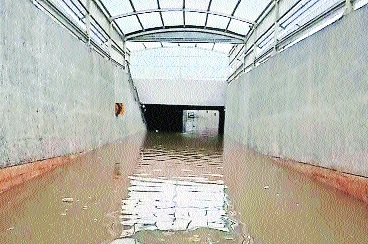
Water-logged Manish Nagar RuB after the July 28 rains.
By Kunal Badge :
Learning from the severe water-logging witnessed during the July 28 heavy rains, MahaMetro has decided to provide independent power supply to sludge pumps installed at key Railway underpasses across the city to ensure uninterrupted operations during heavy rainfall.
The move comes after the Manish Nagar Railway Under Bridge (RuB), equipped with three 20 HP sludge pumps, was inundated and had to be closed to traffic despite assurances that it would remain functional throughout the monsoon.
Explaining the cause of the failure, Rajiv Tyagi, Director (Projects), MahaMetro, said the pumps at Manish Nagar were drawing power from a nearby residential society. “The society’s electricity metres were located in the basement, which got flooded during the heavy rains. As a precaution, the power supply had to be disconnected, resulting in the pumps becoming non-operational,” he said.
According to Tyagi, Maharashtra State Electricity Distribution Company Limited (MSEDCL) stepped in and arranged an alternative power connection on an emergency basis, enabling the accumulated water to be drained within about 40 minutes.
To prevent a recurrence, MahaMetro has now initiated the process of establishing dedicated power connections for pumps at all existing and upcoming underpasses in the city.
Three-layer protection for Freedom Park underpass: The upcoming underpass between Institute of Science (IISc) and Manas Square near Freedom Park Metro Station is also being designed with extensive anti-flooding measures.
Tyagi said the project incorporates a three-layer strategy to tackle waterlogging.
The first layer focuses on preventing stormwater from entering the tunnel through proper drainage planning and surface-water management. The second layer uses the natural gradient of the road alignment to facilitate gravity-based discharge of rainwater from most sections of the underpass. “We have the advantage of natural gradient for nearly 75 per cent of the underpass length, which will allow rainwater to flow out naturally,” he said.
However, the section near the nullah towards the IISc side presents a challenge due to unfavourable gradient conditions. To address this, MahaMetro is constructing a deep sump chamber, approximately four metres below road level, fitted with automatic 20 HP sludge pumps.
“The pumps will continuously remove accumulated water from the low-lying section and discharge it into the drainage network, ensuring that traffic movement remains uninterrupted even during intense rainfall,” Tyagi said.