Spokenwords’unspokenrule
| Date :12-Aug-2026 |
By Biraj Dixit :
How much bad is really bad?
Who draws the line?
Should the line be drawn at bad
or at very bad?
Should it only be a line or a
full circle covering the slightlybad, about-to-be-bad and notas-bad as well?
It is about time the Indian society, which witnessed a churn of
sorts recently, prepare itself to
answer these questions. The agitation at Jantar Mantar and
events that followed, were primarily political in nature. But
they also exposed the society in
many different ways. Class and
crass were open for all to see,
examine and comment about.
And that churn brought out both
‘Amrit’ and ‘Halahal!’
Some recent comments, in
absolute bad taste, against the
Prime Minister outraged our
nation and rightly so. His
age, position and what all he
represents deserves nothing
but respect and decency,
even in criticism. But even
if he had been younger, not the
Prime Minister and did not represent what he does today, a certain Narendrabhai would have
deserved a suitable language
when spoken to or about.
Just like that
As do
all others, irrespective of who
they are or what they represent,
merely by being humans of a
civilised society.
But cast one good look around.
Hear the words spoken on streets,
homes, gatherings, friendly and
unfriendly societies -- the care
for the spoken word is fast losing its grip. Indecent does not
attract raised eyebrows and
uncouth does not offend the way
it should. Social media brings
the crassiest of comments even
on simplest of observations.
People are ready to explode at
any time.
Some 14 years back, a small
boy, around 3 years, playing merrily drew everyone’s attention.
Waiting for the lights to turn
green, people at the signal could
not but notice his innocent play
with shock and despair.
He had
just picked up a dirty, cuss word
and was repeating loudly with gay
abandon. For the boy, he had
learnt something new. For the
crowd, he had learnt something
he should have absolutely not but
the word was around and he had
picked up as 3-year-olds do.
Listening to something so crude
in the soft, sweet voice of a happy child was too glaring, a contrast to be dismissed as a child’s
play. But the crowd at the signal
could do little but dismiss it.
Many perhaps would have cautioned themselves to be more
alert in children’s presence but
that day that cuss word had
already entered the little mind
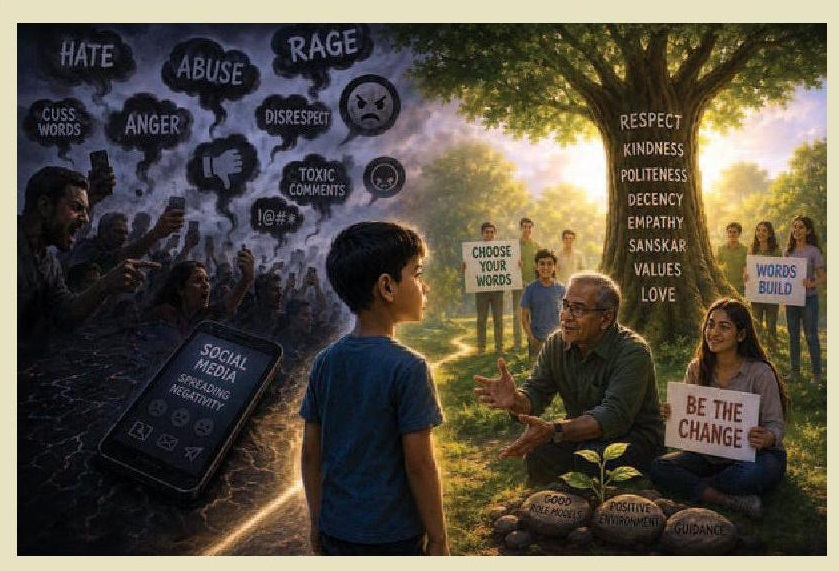
of an innocent boy. Children
watch closely, imitate their elders and pick up things from their
environment.
In forgiving the rogue behaviour against him, the Prime
Minister reminded the nation
the need is not of punishment
but of guidance. The need is also
for better role models.
The need
is also for a protective environment which does not throw foul
language and expects youngsters
to not imbibe it. Why will youngsters shy away from using foul
language against the Prime
Minister, when they have seen
elders speak, in a harsh language,
about leaders – right from the
Father of the Nation, to many
more from different ideological
divides. Shouldn’t we as a society draw boundaries, if only of
respectful language, when we
dissect history or historical figures; politics and political figures, people we do not see eyeto-eye with? The euphoric clapping, when expletives are used
to vilify opponents, also contribute to our Gen Z’s education!
I have heard people speaking
of ‘sanskar’, of parents’ role, of
upbringing, of values. But parents do not man streets, roads,
school and college premises and
every other corner of the nation
including the vast undefined
spaces of social media. The larger society has a responsibility
too. It is high time it took onus.
We knew it when spoken word
in the society was turning bad,
we allowed it to reach the ‘very
bad’, arguing over set of norms
and degrees rather than nipping
things in the bud. Rather than
considering it as a collective duty
we have tried to find those who
could be blamed. The Gen Z with
their outrageous behaviour is the
tree, seeds of which we have
planted.
If we take a sharp U-turn
from using foul language (including at places where we think it
won’t matter if we are not in our
best behaviours, like homes), the
coming generations will follow.
A lot of harm in the society is
done by our looking the other
way. Earlier, a sharp glance, a
raised eyebrow, a frown was
enough to tell a foulmouthed person, that his/her
words were not being appreciated. Looking the other way,
somehow turned our dislike into
acceptance.
The high levels of anger that
could be seen anywhere and
everywhere adds to this culture
of behaving outrageously. Right
now, rage, over petty issues, has
devoured lives, triggered crimes,
made our roads unsafe, and
civilised behaviour a far cry.
The
elders who felt outraged at the
Gen Z behaviour, also need to
find solution to their own rage.
As Sadguru Jaggi Vasudev has
explained that if you want a plant
to grow into a fine tree rooted on
solid foundation, you do not keep
telling it to behave and grow
strong. You add manure to its
soil, ensure that its environment
is free of pests and it gets enough
sunlight and air. If at all we are
truly outraged at the behaviour
of our Gen Z, we elders must
clean our acts first. Use of a better spoken-language, free of cuss
words, polite and kind, to begin
with..!