Years after ‘declaring’ Independence, Baloch struggle continues
| Date :13-Aug-2026 |
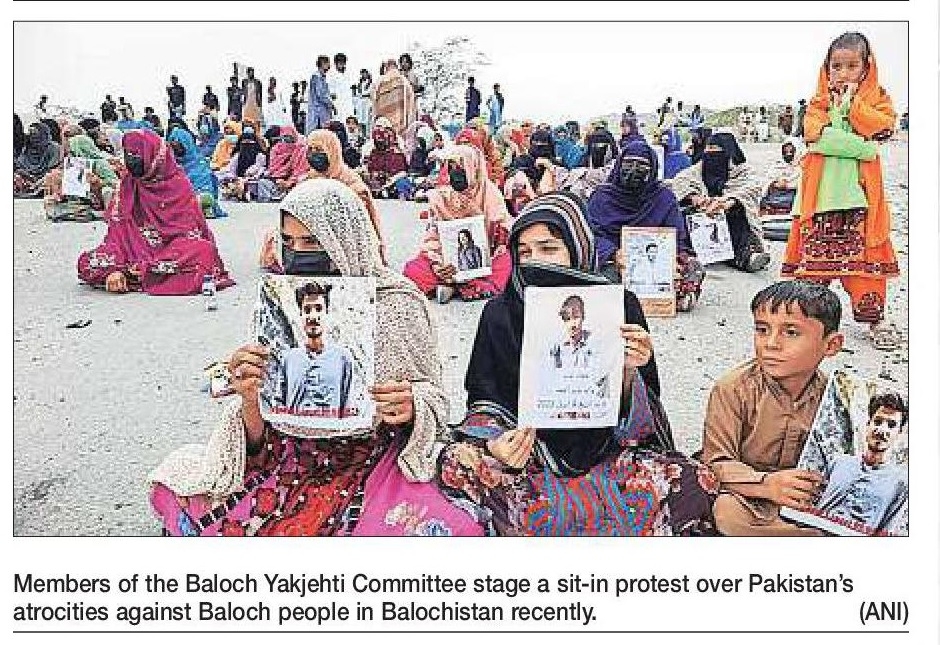
ISLAMABAD :
EVEN after the Human Rights Commission of Pakistan (HRCP) in its 2025 annual report, titled ‘Balochistan’s Crisis of Trust’ raised concerns about the “escalating erosion of human rights and civic space in Balochistan, perennial human rights violations of the indigenous Baloch people continues.
Even in its 2023 fact finding report, ‘Balochistan’s Struggle for Hope’, the HRCP had stated that attention needs to be paid “to the legitimate demands of the Baloch people” including, but not limited to, an end to enforced disappearance, extrajudicial killings, torture, ensuring press freedom in the province, giving the Baloch people due share in the rich natural sources of Balochistan, development and welfare in the province.
Numerous such calls have been spurned disdainfully by the Pakistani state.
In June, according to the Human Rights Council of Balochistan, 63 enforced disappearances were recorded and 77 killings reported.
This is in line with the latest statement issued by HRCP, which said: “Following a fact-finding mission to Balochistan, the HRCP has expressed grave concern over the human rights crisis confronting the province.”
Mobile, internet services remain shut as Balochs celebrate I-Day: In an apparent attempt to suppress the celebrations, Pakistani forces imposed a range of restrictions, including an internet shutdown aimed at preventing people from marking the
occasion.
In June, Mahrang Baloch, the head of the BYC, was sentenced to two life terms by an anti-terrorism court. Although Mahrang was arrested in March 2025 after being accused of having attacked Quetta hospital and “inciting people to violence”, she was sentenced in a different case in which she was accused of having given a provocative speech in Gwadar in July 2024 that led to violent protests and the killing of a security personnel. It shows arbitrary use of criminal law against the Baloch.
The “structural exclusion” is not a recent development in the Islamabad-Balochistan relations but started as early as 1948 when the province was annexed after it had declared independence on August 11, 1947.
As Mohammed Hanif, a renowned novelist of Pakistan, had said in an interview, “Balochistan is considered a remote part of Pakistan not just geographically but in our imagination as well”. This is not a failure to incorporate the province but a deliberate attempt to chasten the Baloch so that they would not raise their voice and demand political and economic rights. Right from the outset, therefore, the policy has been military subjugation of this minority population of the country.
When the local population voted for the locals in 1972, and Sardar Attaullah Mengal became the Chief Minister, he was targetted for supporting and demanding rights for the locals; consequently, his government was dissolved, and he was sent to jail on flimsy grounds.
Later, when his son, Akhtar Mengal, became the Chief Minister in 1997, he was not even consulted by Islamabad when nuclear tests were conducted in Balochistan, the province he was the Chief Minister of. He resigned in protest.
Later, when Akhtar protested against General Pervez Musharraf, he was charged with sedition and jailed.
The abysmal condition of political, economic and human rights in the largest province of Pakistan captures the politicisation of human rights within Pakistan aptly. Not only in the context of the states’ crackdown against Baloch activists and even political leaders, but also, and more importantly, its persistent persecution of the Baloch people and the protesters demanding recovery of missing Baloch people at the hands of the state and accountability of the security forces involved in the extrajudicial killings of the Baloch draw a picture where the targeting of the Baloch has been a common practice. Not only are they maltreated, but they are treated as troublesome people, who can be chastened only by force.
Balochistan is the largest province of Pakistan, forming 43.6 per cent of the total area of the country. Its population density is the lowest, 42.90/km.
The province is rich in natural resources, like gas, gold, copper, oil, precious stones, and chromite.
Despite being rich in natural resources, having a long coastline, and a low population, all the factors that should have helped in the development and welfare of the Baloch people, Balochistan remains the least developed province in Pakistan.
In response to the state highhandedness and the atrocities committed by the Pakistan military, some decided to wage armed resistance and seek separation from Pakistan; others like Akhtar Mengal have remained politically active and tried to seek political accommodation and removal of the past grievances. Still others, like Dr Mehrang Baloch and others have taken the road of protest.
Due to this fragmented approach to the conflict from the Baloch, the Pakistani state legitimises the enemising of the Baloch, even the sections that have not taken up arms but engaged in political and legal ways of seeking a solution to the conflict, like protests.
Thus, groups like Baloch Yakjehti Committee (BYC) and its members have been targetted and sent to jail.
Over 30 Balochs killed in Pak airstrikes
QUETTA,
Aug 12 (IANS)
SEVERAL Baloch activists and human rights groups on Wednesday strongly condemned Pakistani airstrikes in Balochistan’s Surab that killed over 30 civilians, including women and children and injured several others.
Citing local reports, human rights defender Mir Yar Baloch said that the Pakistani Air Force carried out “indiscriminate bombing” of civilian areas in the Gidar area of Surab, killing civilians and causing significant damage to civilian properties.
“According to these reports, hospitals in the affected area have been surrounded by military personnel, while doctors and medical staff are being intimidated and prevented from providing timely medical care. Reports further indicate that some casualties occurred because injured civilians were unable to reach hospitals in time. Residents have also reported seeing drones and Cobra gunship helicopters continuing to patrol the skies over the area,” Mir posted on X.
Condemning the attack, Sabiha Baloch, the central leader of the Baloch Yakjehti Committee (BYC), said that the incident showed how Pakistan marks its formation and existence through the killing of innocent Baloch civilians, including children, which she described as “ genocide”.
Taking to her social media platform X, Sabiha said, “The affected area is surrounded by Pakistani forces, restricting access for rescue teams, medical staff, ambulances, and journalists. Blocking humanitarian assistance and independent documentation compounds the grave human rights violations and demands immediate international attention.”
“I urge journalists, medical teams, humanitarian organisations, and people around the world to demand immediate access to the affected area, ensure medical assistance reaches survivors,” she added.
Meanwhile, human rights body Baloch Voice for Justice (BVJ) called for an immediate, independent, transparent and internationally monitored investigation into the incident.
The rights body further urged the United Nations, UN human rights mechanisms, the United States, the United Kingdom, the European Union, and other members of the international community to end their silence over the “violence and war crimes” against civilians in Balochistan by Pakistani forces.
“Families affected by violence in Balochistan have a fundamental right to justice, protection, and the truth about what happened to their loved ones. The continued silence of the international community risks allowing such incidents to occur without accountability,” it noted.