The ‘silent killer’ hiding in plain sight; Common Krait bites that can go unnoticed
| Date :14-Aug-2026 |
By Rohit Pawar :
The recent Gadchiroli Ashramshala deaths and suspicious death of city’s Pranali were caused due to unnoticed Krait bites
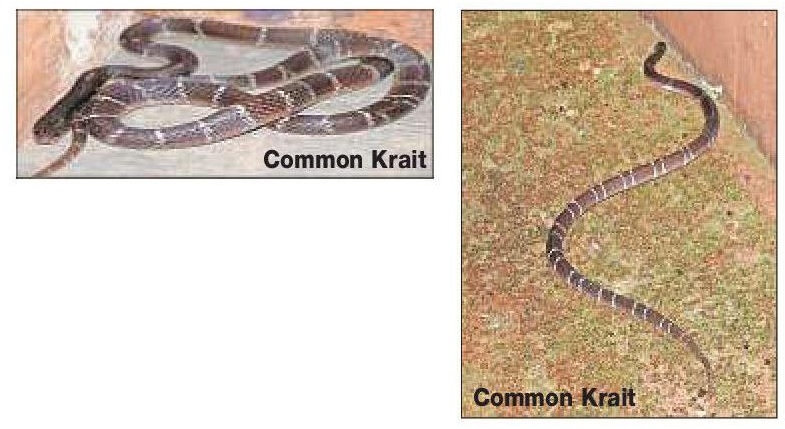
It can kill without leaving behind the tell-tale signs of a snake-bite. The Common Krait (Bungarus caeruleus), known as ‘Manyaar’ in Marathi, is particularly deceptive because its bite can be extremely small, often leaving no prominent swelling, bleeding or discolouration. A victim may not even realise that a snake has bitten him/her, while doctors can also face difficulty suspecting envenomation when there is no obvious bite mark or history of a snake-bite.
The danger is reflected in wider snake-bite burden in the Nagpur division. From 2020 to June 2026, Government hospitals treated 29,720 snake-bite victims,
with 297 deaths recorded over the roughly six-and-a-half-year period. Gadchiroli recorded the highest fatalities at 102, followed by Chandrapur with 67, while Nagpur district recorded 2,775 cases (23 deaths) and Chandrapur highest with 8,879 cases.
The medically important venomous snakes encountered in the region include the Common Krait, Spectacled Cobra (Naja Naja), Russell’s Viper and Saw-scaled Viper. The National Centre for Disease Control’s Standard Treatment Guidelines also note that Krait bites may occur without local signs, making early recognition particularly important. The recent Ashramshala case in Gadchiroli has brought the hidden danger of Krait bites into sharp focus. According to Dr Shashikant Shambharkar, Deputy Director, Divisional Health Services, Nagpur, “Three children reportedly died following Common Krait bites, with the bites occurring mostly on the upper part of the body, including the back and neck.”
“Bites on the upper part of the body can prove more fatal as the venom can affect vital systems more rapidly,” added Dr Shambharkar. The contrast between fatal and surviving cases is significant.
According to officials, those who survived were brought to hospital earlier and received timely treatment. However, two out of three who died reportedly did not realise they had been bitten until symptoms appeared, resulting in a delay in reaching hospital. “Whatever the snake-bite, approach any doctor immediately. Lives can be saved if treatment is started quickly,” urged Dr Shambharkar. Similar case came to light in Nagpur when a 14-year-old girl Pranali, from Koradi, also recently died at a private hospital. A snake expert Nitish Bhandakkar subsequently identified a Common Krait found at Pranali’s home the following day, pointing towards a suspected Krait bite which went unnoticed.
Ample stock of
anti-snake venom available in division
The anti-snake venom stock position dated August 13, shows 48,402 10-ml polyvalent anti-snake venom ampoules available across the six districts of the Nagpur Circle. Chandrapur has the highest stock at 18,568, followed by Gadchiroli (7,481), Nagpur (7,412), Gondia (6,929), Wardha (6,034) and Bhandara (1,978).
The stock statement also lists 3,571 units of lyophilised polyvalent snake-venom antiserum powder. Dr Shambharkar said a minimum of 10 ampoules is required during the preliminary treatment of a snake-bite patient.
Officials say, with an ampoule costing around Rs 4,000-5,000 in the private sector, the initial anti-venom cost can reach at least Rs 40,000. At Government hospitals, however, the treatment is provided free of cost. Health officials stressed that people should not wait for swelling, bleeding or other symptoms after a suspected snake-bite. Absence of a visible wound does not mean the danger has passed.
Immediate medical attention remains the most important safeguard against a preventable delay.