700-yr-old Shiva templedraws devotees withcolour-changing lingam
| Date :17-Aug-2026 |
BEMETARA :
AN ANCIENT Shiva temple in Sahaspur village,
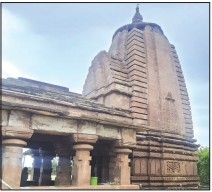
around 35 km from Bemetara, stands as a remarkable confluence of faith, history and architectural heritage. Located near the Bajrangbali temple,
the east-facing shrine is an important example of
the Nagara style of temple architecture.
The temple’s most intriguing feature is its Shiva
lingam, which, according to priest Pandit Prakash
Narayan Sharma, changes colour naturally every
four months. The phenomenon draws devotees
from far and wide, who visit the shrine to witness
what they regard as a divine manifestation. The
temple comes alive during Mahashivratri and the
month of Sawan, when grand fairs are organised.
Thousands of Kanwariyas and Shiva devotees converge here to offer water and prayers.
According to an information panel installed by
the Culture and Archaeology Department of
Chhattisgarh, the temple comprises a sanctum sanctorum, an antechamber and a mandapa.
Its shikhara, crowned with an amalaka and finial,
is characteristic of the Nagara style. The mandapa rests on 16 pillars, each bearing intricate serpent motifs. The entrance lintel features a fourarmed Shiva, flanked by Brahma and Vishnu. The
Navagrahas are depicted below in reverse order.
Inside the sanctum, the Shiva lingam is installed
on a yoni pedestal. The temple’s outer walls are
adorned with sculptures of Nataraja Shiva, Surya
and four-armed Nritya Ganesha, reflecting the
artistic sophistication of its period.
The Archaeology Department estimates that the
temple was built during the reign of the PhaniNaga dynasty rulers of Kawardha in the 13th-14th
centuries. The shrine is currently in good condition and is protected by the Archaeology
Department. With its centuries-old architecture
and enduring religious traditions, the Sahaspur
temple remains a significant heritage site and a
living centre of devotion in the region.