GrandparentingUnder Surveillance
| Date :02-Aug-2026 |
By Aasawari Shenolikar :
Three boys, ages ranging between
seven and three, two were siblings
and the youngest was their cousin,
who was visiting them, were totally engrossed playing games. As
the clock struck one pm, their mothers
emerged like sentinels stepping out from
the shadows, to claim them. Despite the
loud protests from the boys, they were bundled off to their respective rooms - for their
afternoon nap. My sister-in-law, sitting with
me, a witness to this spectacle, simply rolled
her eyes and muttered, “I do not understand this structured form of parenting,”
forcing me to think and triggering another
issue for me to pen down for my column.
As we exchanged notes, the talks centered
around how our generation managed to
survive childhood - without helicopter parenting. As we went down memory lane, she
uttered, “We scraped the paint from the walls
and gobbled it up, no one came rushing
and yelling when we dug up mud and surreptitiously put it in our mouth, shared ice
creams with six cousins without drawing
daggers, drank water from whichever tap
was closest, and considered a biscuit and
a banana a perfectly balanced meal. We
turned out okay.”
I couldn’t agree more.
Years later, when we became mothers, we
were probably more cautious than our parents in bringing up our kids but were definitely not hovering around them 24 x 7, or
keeping close tabs on them, day in and day
out.
Fast forward to 2026, and I am now a grandmother. One would imagine this is the stage
of life where one gets to do exactly opposite of what the parents expect you to do.
Grandparents are supposed to arrive armed
with chocolates, distribute sweets with reckless abandon, and secretly slip an extra
scoop of ice cream when nobody is looking. Sadly, nobody informed my daughter,
who grew up just like I did. Without being
weighed down by rules and regulations.
And she grew up fine, just like I did. We were
apprised of how to bring up our children
by our mothers - we listened, followed the
advice, tweaked it a bit. But generally gave
a free hand to our kids as they were
growing.
Well, over the years, things have changed.
And how! Before my grandson arrived, I
received what can only be described as a
Standard Operating Procedure manual.
It
was not a list. It was a Constitution.
She was following someone called Cara
– Cara’s parenting – apparently Cara has a
huge following and is very popular with parents-to-be.
“No sugar.”
“No salt.”
“No packaged food.”
“No juice.”
“No chocolate.”
“No fried food.”
“No screen time.”
“No deviations from routine.”
By the time I reached the end, I half
expected a clause saying, “No fun.” And this
was when his staple food was supposed to
be his mother’s milk. When I pointed this
out, she scoffed. “I am just letting you know,”
she warned me, knowing my penchant for
cooking and feeding. I was miffed. I might
not have an MBA from IIM, but I do know
that a newborn baby is not to be fed solid
food. Apparently, modern parenting is not
a journey. It is a military operation, which
I became aware of as days passed.
The child wakes up at a fixed hour.
Eats at a fixed hour.
Plays at a fixed hour.
Sleeps at a fixed hour.
Everything is timed, measured, monitored and documented. “Structured,” as
my sister-in-law states, rolling her eyes.
Nap time, especially, is treated with the
seriousness of an international peace treaty.
When it’s time for the afternoon nap, the
entire household springs into action.
Curtains are drawn.
Lights are dimmed.
Doors are closed.
The sound machine is switched on.
Voices are lowered..
Mobile phones are silenced.
I think I have seen less planning during
election campaigns. Going down memory
lane, I pictured my child sleeping anywhere
she collapsed, tired after a day’s play. Sofa,
floor, bed, neighbour’s house - it made no
difference. Today, if the nap is delayed by
seven minutes, experts predict long-term
consequences that extend into adulthood,
sometimes leading to extreme trauma. This
kind of drastic behaviour is not limited only
to sleep. It extends to other areas too.
Restrictions on food are at a different level altogether. My grandson is the sweetest
little fellow, but he is, by default, completely
American. One microscopic speck of pepper and his face assumes the expression of
someone who has accidentally swallowed
molten lava. I offered him a tiny morsel of
khichdi seasoned with what I believed was
an almost invisible amount of pepper.
The
reaction brought the whole household running to the table. “Spicy, spicy,” he yelled.
Water was demanded immediately.
I was looked at suspiciously.
The pepper was blamed.
My culinary reputation was ruined.
Back in our childhood, food contained
enough chillies to clear the entire respiratory system. If you coughed, someone
tapped you strongly on your back, and simply handed you more food. Now every ingredient is analysed like evidence in a criminal investigation.
“What is in this?”
“Is it organic?”
“How much sodium?”
“Any added sugar?”
However, all the regulations are laid down
for her son. When it comes to her father,
she is a completely different person. I watch
her feed her father a steady supply of sweets.
Ice cream?
Certainly.
Cake?
Why not.
Chocolate?
Go ahead.
Another dessert?
Of course.
The same daughter who can detect half
a gram of sugar in her son’s food happily
hands her father a second gulab jamun. One
day I gathered courage to ask her, “How is
sugar dangerous for one member of the family and perfectly acceptable for another?”
Without missing a beat, she replied, “Baba
is old. He can eat what he wants.” Apparently,
old age comes with dietary freedom.
Toddlerhood does not.
The real tragedy is
that grandparents have lost their traditional
role in society. Historically, grandparents
existed for one purpose - to spoil grandchildren.
That is the job description.
Parents enforced rules.
Grandparents broke them.
Parents said no.
Grandparents said yes.
It was a beautifully balanced ecosystem.
Today, however, technology has destroyed
the profession. The daughter can monitor
everything from another room.
Photographs are exchanged.
Videos are reviewed.
Meals are documented.
Evidence exists.
There is no scope for secret operations.
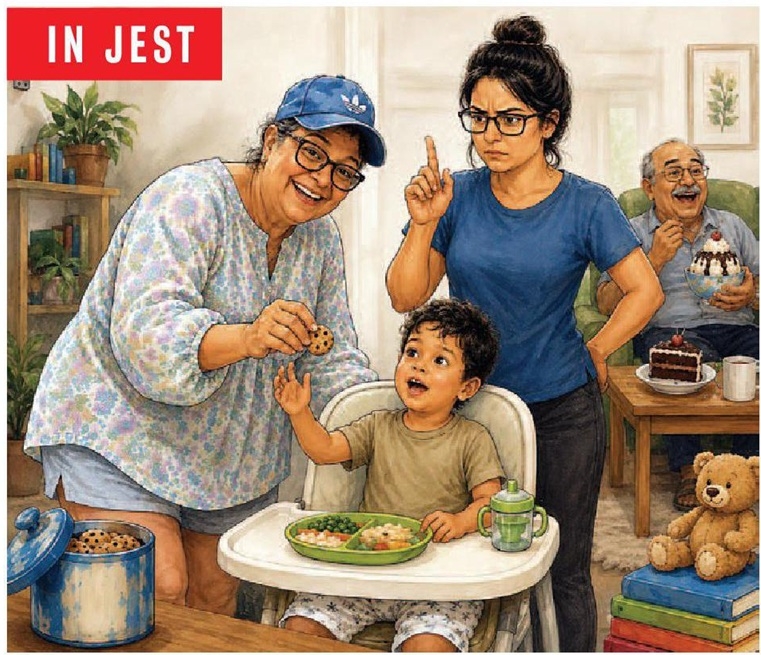
The other day, I considered offering a
tiny piece of cookie.
Not a full cookie.
Not even half.
A microscopic fragment.
Before I could proceed, a voice emerged
from somewhere in the house.
“What are you giving him?”
I nearly dropped the evidence.
Honestly, I feel like a prisoner attempting an escape. Every move is under surveillance.
But what took the cake was when I sat
down to read a book to him. He picked up
Panchtantra, as that was a new book, gifted to him, well, by us. As I started narrating the stories, she rushed in. “Aai what are
you reading to him?” “The same stories that
you grew up with,” I responded.
“Don’t you think these stories reflect cruelty. I mean, look at what you just read –
the lion killed the donkey, the sly fox ate his
brain. Killing, dead - these are not words
that I want him to be exposed to at this age.”
“Wasn’t Baazigar the first movie that you
saw in the theatre? How old were you then?
Just a little over three - right. As far as I can
recall, Baazigar had a lot of gore. You survived, didn’t you, without any kind of post
movie trauma,” I huffed. Times have
changed, she stated.
Yes, I agree. With time,
each generation evolves, adopting new perspectives, values, and ways of looking at the
world and dealing with situations. And so
despite all my complaints, I must admit these
young parents are doing something right.
Their children eat healthier than we ever
did. Their routines are more structured.
They know far more about nutrition than
our generation did. We raised children with
instinct, advice from neighbours and occasional guesswork. They raise children with
research, experts and apps. The world has
changed. Parenting has changed.
Only grandparents remain gloriously
unchanged. We still believe that happiness
can occasionally be measured in cookies.
We still think an extra cuddle solves most
problems. We still secretly feel that a little
indulgence never harmed anyone.
So I continue to obey the rulebook.
No sugar.
No salt.
No pepper.
No unauthorised snacks.
No deviation from the sacred schedule.
But every now and then, when my grandson flashes that irresistible smile, I understand why grandparents throughout history have struggled with rules.
After all, spoiling grandchildren is notmerely a habit. It is an ancient tradition.
And traditions, unlike nap schedules, are
very hard to break.