Indian classical music is foundation of all music: Pt Ronu Majumdar
Date :02-Aug-2026
By Reema Mewar :
A raga can be performed a hundred times. Yet, according to Padma Shri flautist Pt Ronu Majumdar, it is never the same twice. The notes may belong to the same composition, but the performance changes with every concert, every audience, and every moment. That freedom to improvise, he believes, is what sets Hindustani classical music apart. “Indian classical music is the foundation of all music,” he stated.
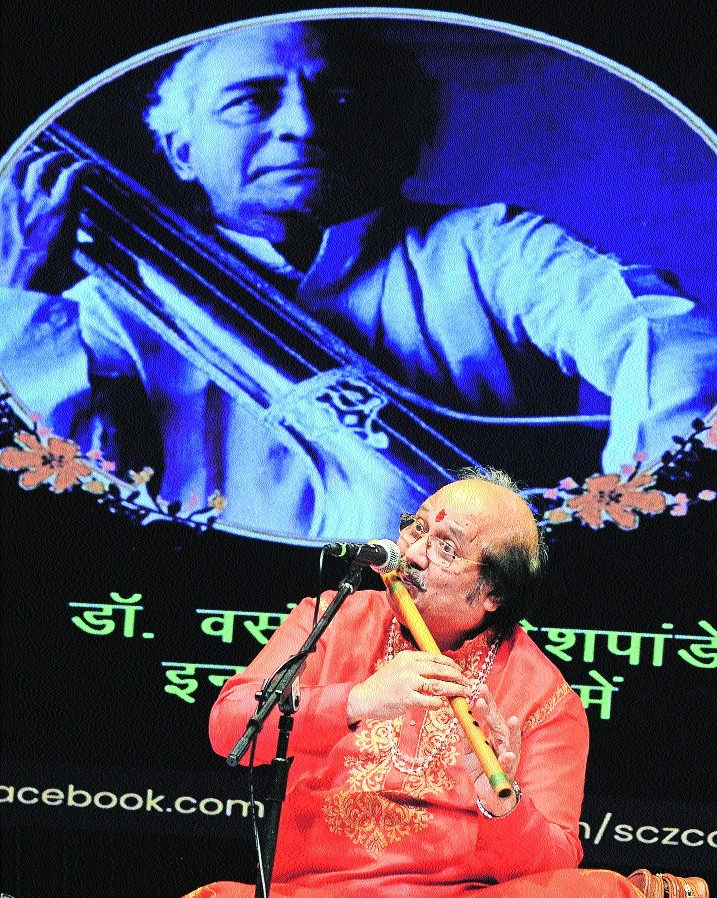
“Our music is not written music,” he explained. “Though we can write it when needed, it is all improvised. We don’t read and play like a symphony orchestra. We create the picture on the stage.” That is also why, he insists, repetition is impossible. “On Friday evening in Nagpur, I played Raag Ramdasi Malhar. If I play it today again, it will be different. There will be no repetition.” For listeners, the raga may remain the same. For the musician, every performance is a blank canvas.
This depth of understanding he has of his art explains why Pt Majumdar remains optimistic about the future of the tradition.
Over the years, Pt Majumdar has performed with jazz musicians, orchestras, film composers, and artists from different musical traditions. Those collaborations did not dilute his foundation in Hindustani classical music. They strengthened it. “They have made me a better person and a better musician,” he says.
“I always meet my co-artist halfway. I listen to what he or she wants to say. I am not one to say ‘my raga is the best’ or ‘you have to play the way I ask you to’.” He believes that willingness to listen has been the reason many of his collaborative projects continue to be popular in India and abroad long after they were first recorded. The conversation inevitably turns to artificial intelligence (AI).
“Music generated by AI is already becoming commonplace, and it does have the potential to affect composers and creators.,” he acknowledges. But he is unconvinced that it could match human imagination. “As long as Indian classical music continues to be created in the moment rather than reproduced, its core will remain untouched.”
Pt Majumdar admits he had heard a few AI generated songs or music, but found them to be rather monotonous, and lacking soul and creativity, the very essence of Hindustani classical music. “Original will always remain original. AI cannot replace original creativity,” he states.
Still, his concerns about the future of classical music lie elsewhere.
According to him, more young people are learning the flute today than ever before. The instrument has found a place in film music, fusion, and contemporary performances, making it attractive to a new generation. The real challenge, he feels, is getting that generation to sit through a classical concert. “I think they are scared to listen to classical music because they think they won’t understand it,” he says. “We have to bring them to the auditorium somehow. Once they listen to it, they will definitely love it.”
Pt Majumdar also pointed to changes that have reshaped the profession itself. With CDs and cassettes disappearing, recordings now live almost entirely on digital platforms. While that has expanded access, it has also made earnings less predictable.
“We don’t know how much it is selling, how much royalty is coming,” he said. “In my earlier career, I used to get very handsome payment for my CD recordings.”
Yet his outlook remains unchanged.
“I see a very bright future for Indian classical music because it is the foundation of all music,” he says. He believes schools and colleges should introduce Indian classical music as a common subject rather than leaving it as an optional choice. For Pt Majumdar, the future of the tradition will not depend on resisting change. It will depend on ensuring more people experience what a live performance can offer -- something that, by its very nature, can never be exactly the same twice.