Soham: Sacred Breath Sound
| Date :02-Aug-2026 |
By DR BHUSHAN KUMAR UPADHYAYA :
A
ncient Yogis were great
observers of the human body.
They discovered the whole
science of Yoga based upon the
mechanics of the body, breath,
emotions, and consciousness.
Amongst all the forms of Yoga, the
breath practices popularly known
as Pranayama are the most potent
tools to calm the mental chatter
and connect to the inner self.
Right from the Upanishads to the
other classical Yogic texts, we find
that the breath work has got the
prime position in the framework of
the Yogic philosophy. Different
types of Pranayamas are prescribed
in different Yogic books. The
Soham Pranayama occupies a
unique position in the spiritual traditions of India.
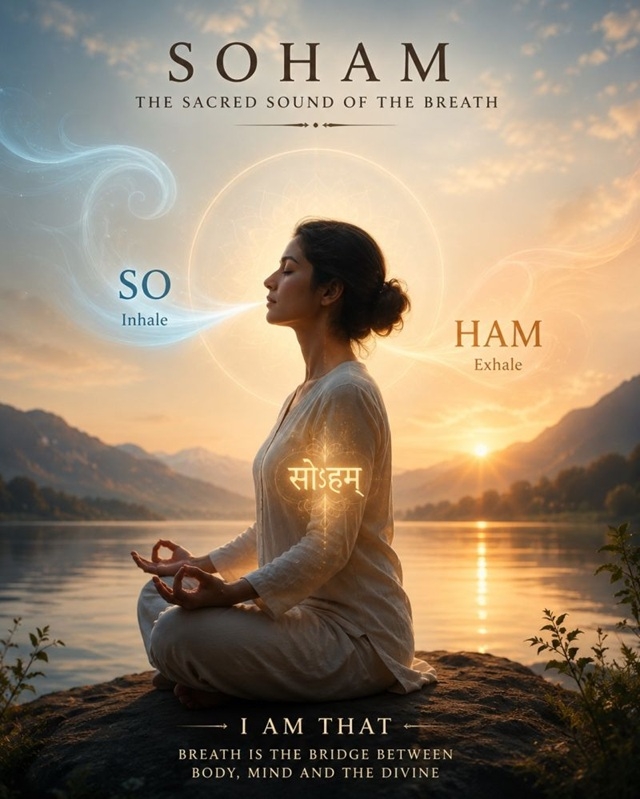
Ancient Yogis observed that our
breath produces sounds and that is
SO when we inhale and Ham
when we exhale. Listening to this
Soham sound in the natural flow of
breath is considered a great Yogic
Sadhana. It literally means - That I
am. It symbolizes that the individual consciousness is interconnected with the cosmic consciousness.
Our breath incessantly chants this
Mantra of Soham. This discovery is
rooted in the Upanishadic
Mahavakyas: Tattvamasi - That
Thou Art and Aham Brahmasmi- I
am the Ultimate Reality.
The Chudamani Upanishad,
Shiva Swarodaya , and Hatha Yogic
texts prominently describe this
spiritual practice. It is the mystic
experience of the practitioners that
in the deep meditative state the
Soham sound gets reversed to
Hamsa meaning the swan , a symbol of purity and liberation.
The beauty of the Soham Japa is
that the awareness is synchronised
with inhalation and exhalation,
leading to Pratyahara, Dharana,
Dhyana, and Samadhi. After the
sustained and regular Soham meditation, breath becomes a bridge
between the body, the mind , and
consciousness. The ordinary breath
transforms into the mindful breathing. Awareness turns towards
internal stillness from the external
distractions.
Examined from the neuroscientific standpoint, it is found that
slow and rhythmic breath stimulates the vagus nerve and the
parasympathetic nervous system,
responsible for the rest and digest
state of our body. This type of
breathing enhances heart rate
variability and builds a great emotional resilience.
It is proven that
the reactivity of the amygdala is
reduced and stress hormones come
down. It is observed that the function of the prefrontal cortex
improves and attention becomes
sharp with great cognitive control.
Psychologically, mindfulness
increases and anxiety decreases.
The regular practice cultivates
emotional balance and responsive
behavior. Self awareness takes the
centre stage in the process and the
decision making becomes calculated and measured.
It is the experience of the practitioners of the Soham Sadhana that
the illusion of separateness disappears and one feels as the inseparable part of the infinite web of
consciousness.
Meditation turns
from doing to being. Breath synchronicity activates the larger parts
of the brain and the brain becomes
neuroplastic ready to adapt and
respond.
Thus, Soham Japa is more than a
Mantra, it is a natural rhythm and
pulse of life being expressed in the
form of breath . It integrates our
entire existence right from the
body to the emotions and intellect.
It is considered the great path to
self realisation. The natural sound
of the breath reminds us that we
are the inseparable part of the
Divine .

(The writer is Former DG Police
& CG, Homeguards,
Maharashtra)