What not to do is more important than what to do: Ashok Saraf
| Date :20-Aug-2026 |
Staff Reporter :
“What not to do is more important than what to do,” said Maharashtra Bhushan and Padma Shri awardee actor Ashok Saraf while reflecting on his six-decade journey in cinema and theatre at a civic felicitation organised at Dr Vasantrao Deshpande Hall, Civil Lines on Wednesday.
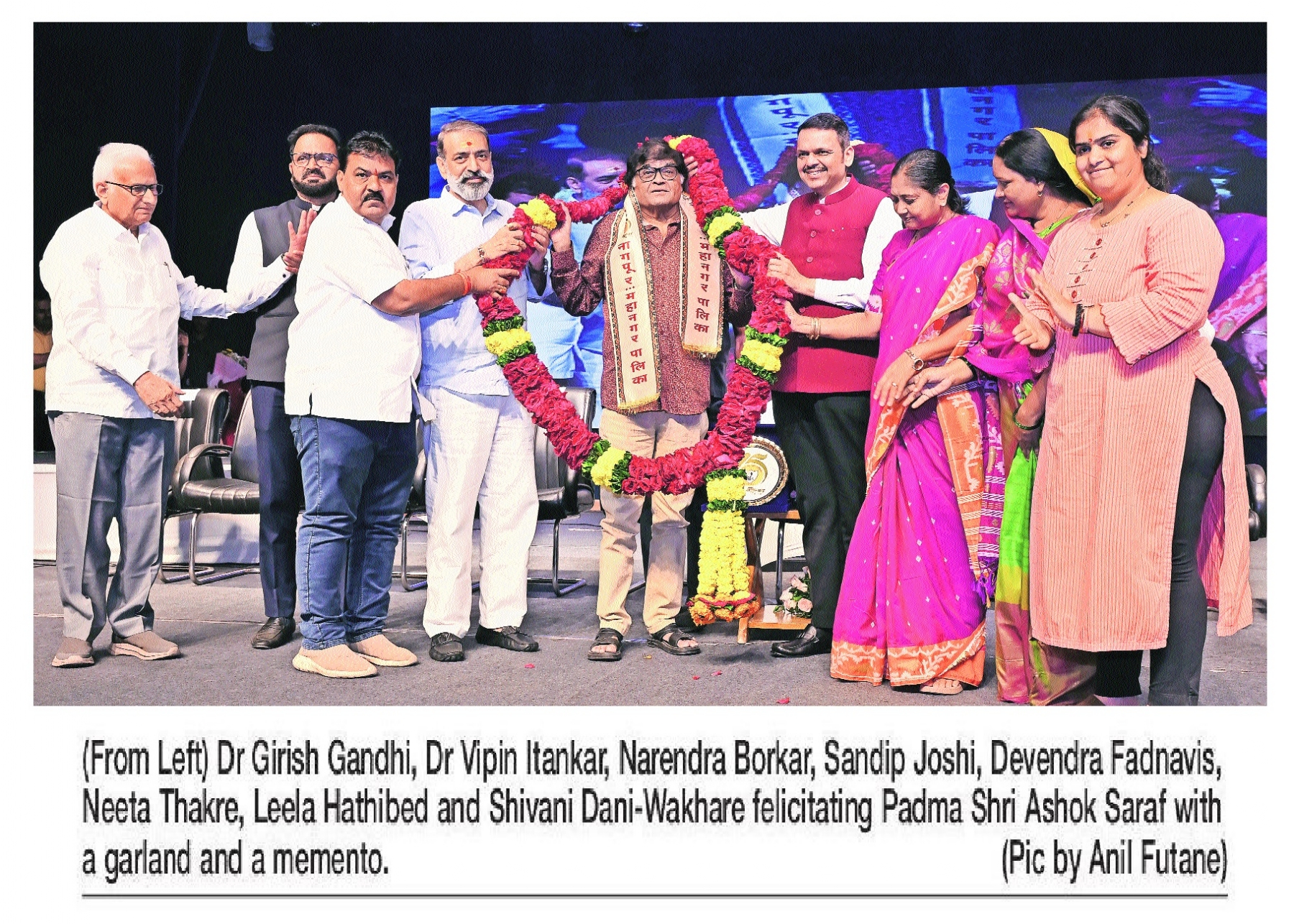
Chief Minister Devendra Fadnavis felicitated the veteran actor at the ‘Nagri Satkar Sohla’, organised by Shri Siddhivinayak Seva Trust, Vidarbha Gaurav Pratishthan and Nagpur Municipal Corporation (NMC). Saraf became emotional while recalling his journey and said that having his art loved by people was the biggest achievement of his life.
Dr Girish Gandhi, president, Vidarbha Gaurav Pratishthan, Sandip Joshi, president, Shri Siddhivinayak Seva Trust, Mayor Neeta Thakre, Deputy Mayor Leela Hathibed, Shivani Dani Wakhare, Narendra Borkar, Sanjay Mahakalkar, Dr Vipin Itankar,
Padma Shri Dr Vilas Dangre, Padma Shri Chandrashekhar Meshram, celebrity chef Vishnu Manohar, Shital Mahajan and Dayashankar Tiwari were among those present. The programme featured a special interactive session, ‘Dilkhulas Gappa’, in which actor Pushkar Shrotri engaged Saraf in an interview-style conversation about his career, craft and experiences. Recalling his childhood, Saraf, fondly called Mama, said he had been playing the tabla since the age of six, although he had never formally learnt it. “Rhythm came naturally to me from childhood, and it helped me enormously with comic timing,” he said. He recalled learning the nuances of acting from his maternal uncle Gopinath Savkar, particularly the importance of timing and rhythm. Saraf recalled his 1975 film ‘Pandu Havaldar’ and said he had visited Kohinoor theatre to watch the audience’s reaction.
“When I entered, nobody recognised me. After three hours, when I came out, I could not leave because of the crowd,” he recalled. He said ‘Gondhalat Gondhal’ changed the grammar of comedy in Marathi cinema. While comedy earlier relied largely on dialogue and situations, he was the pioneer of action and physical comedy in Marathi Cinema. Saraf also recalled sharing the screen with Laxmikant Berde in nearly 50 films and said Berde had been inspired by him. He remembered the contribution of writers such as Vasant Sabnis and the distinctive folk-theatre style of Dada Kondke. He stressed that good writing remains central to a successful film. “The story is what attracts the audience,” he said.
Speaking about theatre, Saraf said improvisation and repeated performances help an actor develop. His play ‘Hasat Khelat’, staged after a 12-year gap, went on to complete around 400-500 shows.
“Every performance should be like the first performance,” he said. Saraf also spoke about his desire to explore serious roles, recalling films such as ‘Bhasm’, ‘Vazir’ and ‘Apli Mansa’. For him, imagination was more important than merely imitating someone while creating a character. He also praised his wife Nivedita Saraf for her contribution to his life and journey. Fadnavis said the honour was a celebration of the happiness Saraf had created among generations of people and said he had given Marathi cinema a distinct stature through his versatile performances. He recalled Saraf’s popular television series ‘Hum Paanch’ and his efforts to help others in the industry.
As part of the ceremony, five women performed the traditional ‘80 divyanchi aukshan’marking his 80th year of birth. Mayor Thakre and Deputy Mayor Hathibed, along with Shivani Dani-Wakhare, joined the ceremony. A golden Vatvruksha, specially designed as a memento, was presented to Saraf by Shri Siddhivinayak Seva Trust. Mayor Thakre welcomed Saraf on behalf of Nagpur and paid tribute to his enduring legacy in Marathi entertainment.