GIB can reclaim Deccan range if low-intensity farming, land use practices revive: Study
| Date :23-Aug-2026 |
Staff Reporter :
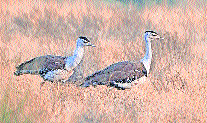
The critically endangered Great Indian Bustard (GIB) can reclaim parts of its historical Deccan range if traditional, low-intensity farming and land-use practices are revived, claimed a PLOS One study recently.
A study titled ‘In Search of Safe Havens: Identifying priority conservation areas for a critically endangered bird, the Great Indian Bustard, in the Deccan Landscape of India’ published in PLOS One journal stressed conserving fallow lands, mixed crops and grasslands to enable re-introduction and population recovery. The critically endangered Great Indian Bustard (GIB) has vanished from most of the Indian Subcontinent, especially the Deccan Plateau.
The researchers modelled a probability distribution map and identified priority conservation areas for the GIB in the Deccan landscape.
They also mapped 7,20,000 sq km Deccan landscape and identified 16 priority conservation sites spanning 18,000 sq km as viable recovery habitats.
The study authored by wildlife biologists Shaheer Khan, Gautam Talukdar and Bilal Habib from the Wildlife Institute of India (WII). The researchers also identified 16 critical sites that totalled 18,000 sq km, ranging from 144 to 8,496 sq km, as priority conservation areas by conducting a landscape-level survey and species distribution modelling.
The most current estimate places the population in a range between 100 and 150 individuals. However, this population range is wide for critically endangered species, which impedes implementation of any conservation measures. The largest population of
GIB is found in Rajasthan, and the remaining states, Gujarat, Madhya Pradesh, Maharashtra, Karnataka, and Andhra Pradesh, have 10–15 individuals. The bird has completely disappeared from the northern parts of India, and the current populations of Maharashtra, Karnataka, Telangana, and Andhra Pradesh (Deccan landscape) are at a high risk of local extinction. As per the study, the potential suitable areas of Deccan landscapes were distributed in 35 districts -- 22 in Maharashtra, six in Karnataka and Telangana, and one in Andhra Pradesh. The study revealed that suitable habitat for GIB comprised 7.49% of Maharashtra’s total area, 5.59% of Telangana, 4.48% of Karnataka, and 0.02% of Andhra Pradesh within the Deccan Landscape. In Maharashtra, Osmanabad and Solapur districts showed the highest suitable area of 66.97% and 50.91%, respectively followed by Warora in Chandrapur district.