Pause that heals the brain
| Date :23-Aug-2026 |
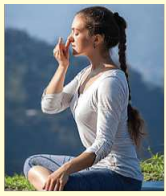
By DR BHUSHAN KUMAR UPADHYAYA :
Yoga is designed to calm the
wandering waves of the
mind. Pranayama plays a vital
part in this Yogic framework.The
most transformative part of
Pranayama is the silent pause
between inhalation and exhalation. Ancient Yogis have called it
Kumbhaka. Modern neuroscience
provides sufficient insights into
why brief stillness in breath has
very profound effects on the body
and the mind.
It is a fact that most people
breathe without awareness. Their
breath is imbalanced, jerky, and un
harmonious. Consciousness breathing introduces gaps between
income and outgoing breaths,
influencing the body and the brain.
Actually, this pause is not a break,
but a great physical and psychological rest.
In the classical Yoga texts we
find mainly three types of
Kumbhaka - Antah , Bahya, and
Kevala. Antah Kumbhaka is the
gap when breath stops after
inhalation.
On the other hand
Bahya Kumbhaka occurs after
exhalation. Kevala Kumbhaka is a
very high level of Pranayama when
breath is suddenly suspended during the deep state of meditation.
Neuroscientifically, during
Kumbhaka respiratory muscles
slow down. The brain receives
lesser stimuli from outside.
Temporary reduction in breath is
the window of inner silence.
Controlled Kumbhaka stimulates
the autonomic nervous system. It
improves the communication
between the brain and the heart.
Parasympathetic activity increases,
leading to deep relaxation. Light
breath retention increases vagal
tone. Better vagal tone enhances
emotional stability and mental
resilience. The amygdala, the fear
and stress centre of the limbic system is calmed down. As a result,
fear, anxiety, and emotional reactivity reduce.The prefrontal cortex
gains control. Better executive
functioning leads to better decision
making. It improves attention and
focus. Impulsive behavior gives
ways to a responsive attitude.
Neural oscillations become more
coherent.The functional connectivity of the different parts of the brain
improves.
It has been found that regular
practice of Pranayama leads to
neuroplasticity of the brain. As the
brain becomes more calm and still,
it forms new neural circuits. The
adaptability of the brain enhances .
The carbon dioxide tolerance
increases due to temporary retention of breath and increase in the
quantity of carbon dioxide. The
capacity of the brain to bear psychological stress also enhances as
a result of this process. Due to carbon oxide tolerance, the oxygen
delivery of the cells improves. EEG
studies found that such rhythmic
breathing with small phases
increases alpha and theta waves in
the brain.The practitioner experiences relaxed alertness rather than
drowsiness. This state of the mind
contributes to mindfulness and
better self regulation.
This Pranayamic practice has
been found to reduce repetitive
thought processes. This matches
with the announcement of Yoga
that calming down of the modifications of the mind leads to inner
awareness. This happens because
the pause between breaths causes
pause between thoughts also.
Silent pause of breath is not
emptiness, but full of peace and
bliss. These pauses reshape emotional health, calm the nervous
system, and transform the brain.
Yogic texts caution about the
practice of Kumbhaka. First, one
must learn the proper technique of
Kumbhaka from a Yogic expert. It
should be practised with great
caution and there should never be
any forceful retention of breath.
After sustained and regular practice over a longer period of time,
this Pranayamic pause happens
naturally.
(The writer is Former DG Police
& CG, Homeguards,
Maharashtra) ■