Education beyond academics How Upay NGO uplifts marginalised communities, one child at a time
| Date :24-Aug-2026 |
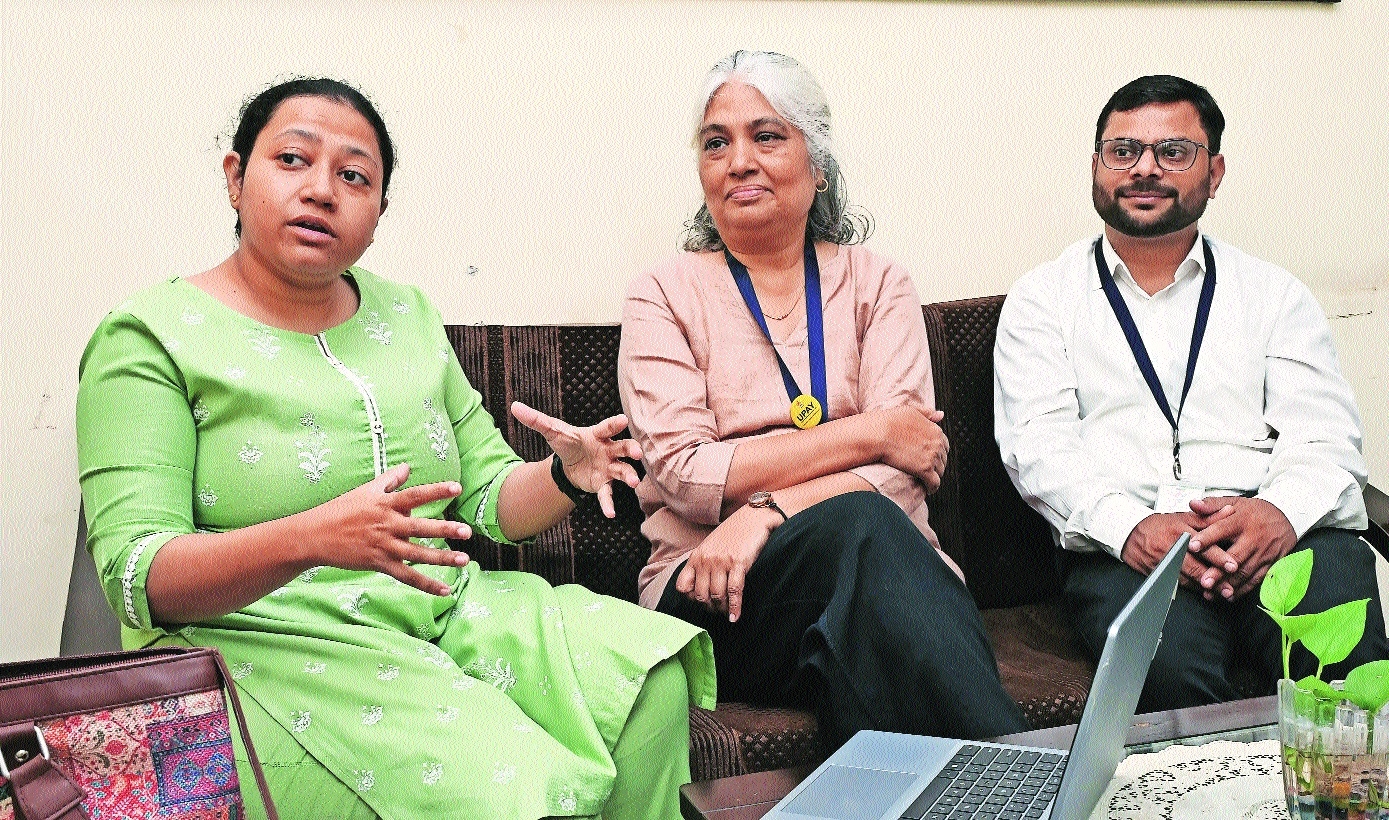
(From left) Deboshree Bhattacharya, Dr Kamayani Deshpande, and Prince Singh interacting with ‘The Hitavada’.
By Reema Mewar :
There was a time when some parents saw education as a threat. If their children studied, who would go and beg? Who would pick rags? This is the narrative that ‘Upay’ (Underpriviledged’s Advancement by Youth) has spent years trying to change in the country’s marginalised communities. Upay runs free learning centres for children from disadvantaged backgrounds in places like Mouda, Nagpur, Banglore, Delhi, Pune, and other cities across India.
Their work, however, is not limited to education. “You cannot go to a slum or footpath where people reside and immediately start teaching the alphabet or numbers,” said Dr Kamayani Deshpande, Trustee Member, Upay. “First, you have to understand what that community needs and gain the children’s trust. We dedicate at least six to eight months for this process. We play games, chat, talk about hygiene, and address concerns like health issues, sanitation, and other such things. These children have seen a very difficult life. Some have lived on the streets and dealt with abuse and insecurity, but once they begin trusting you, they open up and become very eager to learn.”
This trust is not easy to gain. “Parents used to tell us that we were wasting the children’s time,” said Deboshree Bhattacharya, Executive Director, Upay. “They felt we were spoiling them because if they studied, they would not go to work. Some children were even stopped from coming. That resistance did not disappear quickly. But now we see children who studied with us grow up and become parents themselves. Many of them could not continue their education, but they are now sending their own children to us. That is where the change becomes visible across generations.”The organisation’s idea of is not limited to whether a child can read or write. “There is health, nutrition, cleanliness, personal safety, sex education, and awareness about substance abuse.” Deboshree said.
Upay’s work relies heavily on volunteers, but retaining them for the long term remains one of its challenges. Prince Singh, Regional Coordinator, explained that the organisation’s original model was not meant to depend indefinitely on outsiders coming into a community.
The idea was that children who had studied at its centres would eventually grow up, pursue further education and return to teach younger children from the same community. “They understand the nuances of the community because they have lived there,” Singh said. “They know the challenges, the families, and the children better. They also become role
models.”
The model has worked in some of Upay’s rural centres, where former students have been trained to take on teaching responsibilities. In Nagpur, however, the organisation continues to rely substantially on external volunteers.
“Many people come because they feel social work is something good to do, which we deeply appreciate,” Dr Deshpande said. “A lot of volunteers are students or working professionals, so they may not be able to commit every single time, which we understand. However, that disrupts the children’s schedule, and that is not something we want to compromise on. Having long-term volunteers will hopefully help us bridge
that gap.”
Finding a regular place to teach is another challenge. Upay initially held classes on roadsides, but Deboshree said that this is not feasible forever. “There are vehicles, honking, and people constantly moving around. It becomes distracting for children who are trying to study,” she said. “Parks can become unsuitable during the monsoon, due to mosquitoes and a lack of covered spaces.”
“We had approached the Nagpur Municipal Corporation (NMC), seeking access to classrooms for a few hours in the evenings.
We told them even their own students who needed additional academic support could join us, completely free of cost. But that did not work out.” Dr Kamayani Deshpande said. “We do not necessarily need a school setup. An unused garage, a vacant room, or any safe place where children can sit undisturbed for a few hours would help us. We have centres in IT Park, Sitabuldi, Mount Road, Wardhaman Nagar, Sakkardara, Jagdish Nagar, and some other places.”
For Upay, the measure of success may ultimately be a simple one: when the children it once taught no longer need to be persuaded to learn, and begin persuading the next generation instead.