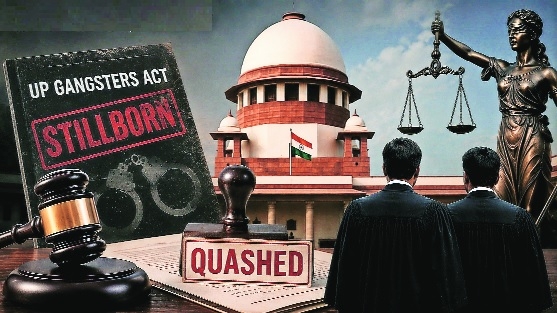
Gangsters Law Stillborn!
| Date :24-Aug-2026 |
By Adv. R. S. Agrawal :
On a complaint raised by one individual regarding the conduct of elections, the Bar Council of UP issued a communication on September 7, 2018 directing the elections to be conducted in accordance with the Rules and applicable Law. On allegations raised regarding the conduct of elections, five advocates were debarred from
practicing for a period of ten years, including the appellant by
proceedings dated February 9, 2019.
THROUGH two Criminal Appeals, the proceedings initiated under the Uttar Pradesh Gangsters and Anti-Social activities (Prevention) Act, 1986 and the Uttar Pradesh Gangsters and Anti-Social Activities (Prevention)Rules, 2021 were successfully challenged before the Supreme Court by Shiv Pratap Singh alias Chinu and Himanshu Srivastava.
The apex-Court’s verdict has been pronounced by Justice J.B.Pardiwala and Justice K.Vinod Chandran, on August 20, 2026. At the top of the judgement, the Judges have quoted George Orwell saying: “Those who abjure violence can do so only because others are committing violence on their behalf”.
In Shiv Pratap Singh’s Appeal, a practicing Advocate who was involved actively in a dispute with respect to the elections to the Bar Association, Fatehgarh, Farrukhabad.
On a complaint raised by one individual regarding the conduct of elections, the Bar Council of Uttar Pradesh issued a communication on September 7, 2018 directing the elections to be conducted in accordance with the Rules and applicable Law.
On allegations raised regarding the conduct of elections, five advocates were debarred from practicing for a period of ten years, including the appellant by proceedings dated February 9, 2019.
The Bar Association challenged the said impugned communication of the Bar Council before the High Court.
The HC struck it down through its judgement on July 11, 2019, holding it without jurisdiction, following its an earlier Division Bench judgement. The HC also observed that the elections of the Bar Association to be held as per the Byelaws.
Again, the proceedings were taken by the Disciplinary Committee of the U.P. Bar Council and an order was issued on July 16, 2023 debarring the appellant and one Sanjeev Paria from practicing for 15 years with further direction to lodge a complaint before the Superintendent of Police Farrukhabad with a like request to the District Judge/ Chief Judicial Magistrate. The Elders Committee of the Bar was also requested to conduct the election.
The appellant has alleged that he was not heard in the matter and he had just appeared before the Disciplinary Committee representing the other Advocate Sri Sanjeev Paria.
After the complaint made by the Disciplinary Committee a FIR was registered at the Police Station under various provisions of the IPC. Later to this, the direction issued by the U.P. Bar Council on July 16 2023 was stayed by the HC. Subsequent to this, the Bar Council of India declared the U.P. Bar Council’s orders a nullity.
Thereafter, the Police registered FIR under the Act along with two others arrayed as accused.
A reading of the FIR shows general allegations without any specifics; that Sanjeev Paria is gang leader and the two other members together as a criminal gang commit offences and induce fear and terror among the general public which makes their free movement, against the interest of the general public.
The Charge –sheet was filed on February 12, 2025 against which an application was filed under section 482 Cr.P.C. and the same was rejected by the impugned judgement in one of the appeals.
Placed in juxtaposition with a preventive detention statute, the U.P. Act fails to satisfy the judicial conscience. The trial is grossly inadequate, since on determination of status, mandatory imposition of punishment follows.
However, compelling and threatening the social menace, any penal enactment to curb that, It cannot lead to arbitrary and capricious actions against the one, alleged with the commission of an offence.
The mere allegation of an offence under clauses (i) to (xxv) of section 2(b) can motivate the preparation of a gang chart, which can lead to the arrest of a citizen and his remand which could be continued for one year without closing the investigation.
There is no safeguard against vindictive and malicious action being taken against the innocent , righteous, the virtuous, a whistleblower or plainly put, a thorn in the flesh’(quoted from Thankam v. Keralam and others-(2018) SCC OnLine Keralam 4927).As the SC has noticed the U.P. Act is stillborn and the proceedings under it cannot survive.
Both these appeals have been allowed and the proceedings impugned in the respective appeals have been quashed and set aside. The appellants, in custody, to be released forthwith, if not required in any other case.
Taking a cue from George Orwell, the SC has observed that the enactment under scrutiny on the pretext of adjuring violence, is in fact perpetuating it on un-suspecting citizens.
The SC has made it clear that it has not gone into aspect of constitutionality as argued before the Full Bench of the Allahabad HC, which were negated by that Court.
The Court has found the Act to be stillborn, since there is no crime created under the Act and this will not in any manner affect the charges leveled under the other penal laws, which have to proceed on the lines demarcated in the Cr.P.C. and the respective penal statute, which makes the objectionable act, an offence under law.
The SC has also made it clear it has not upheld the Gujarat Act or the Maharashtra Act referred to by the Court and the attempt was only to draw a distinction from these; of the creation of an offence under those Acts being totally absent in the U.P. Act.
The SC has stated that the Court may not be wrong as having approved the Full Bench of the Allahabad High Court‘s decision or upheld the negation of all the contentions raised against the Act, which would be left open for consideration, especially since the Court has only held the Act to be stillborn on the provisions as existing now. In result the Supreme Court has allowed the appeals.