The inspiring tale of HALKU BARMAN
Date :27-Aug-2026
Staff Reporter :
IT’S A real story which teaches
how even a poor farmer can
earn better livelihood by leveraging agricultural innovations.
Halku Barman, a farmer from
Bhita village under Shahpura
block in Jabalpur district, has
successfully transformed a lowyielding parcel of land by combining water chestnut (singhada) cultivation with aquaculture, establishing an effective
alternative to traditional Kharif
paddy farming.
Barman has around three
acres of leased land. Previously,
a 0.25-acre section presented
significant logistical challenges
during Kharif season because
geographical constraints prevented combine harvesters
from accessing the plot. The
resulting reliance on manual
labor for paddy harvesting substantially increased operational
costs and time expenditure.
Following guidance from local
agricultural officials, Barman
transitioned this water-logged
area into an integrated dualcrop aquaculture system.
The biological synergy of the
plot allowed water chestnuts to
grow on the surface while compatible freshwater fish species
thrive in the underlying water
column, maximising land-use
efficiency and diversifying revenue streams.
The 0.25-acre
plot now generates an additional Rs 30,000 to Rs 40,000
from water chestnuts and Rs
25,000 to Rs 30,000 from fish
sales per season. Beyond his
Kharif operations, Barman
practices crop rotation on his
remaining land, growing peas
and vegetables during the Rabi
season and black gram (urad)
in the summer. He further integrates livestock management
into his enterprise, using organic by-products such as cow
dung and urine as farm manure.
This integrated farming framework yields an aggregate net
annual income of around Rs
4,00,000.
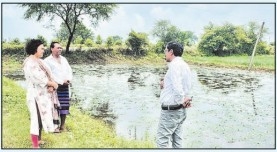
Sub-Divisional Agricultural
Officer (Patan) Dr Indira
Tripathi and Senior Agriculture
Extension Officer (Shahpura)
S K Parteti recently conducted
an official field inspection of the
site, alongside local farmers
Golu Tiwari, Mahendra Pal and
Puran Singh. Dr Tripathi highlighted the model as a viable
strategy for small and medium-scale farmers managing
prolonged water-logged conditions or machinery-restricted fields.