From ‘Desi’ to Distinct MAFSU project aims to unlock hidden value of Vidarbha’s native cattle
| Date :06-Aug-2026 |
By Rohit Pawar :
Sold simply as “desi” cattle in village markets for generations, Vidarbha’s native bovines could soon acquire recognised breed identities—and with them, greater market value. Backed by the 20th Livestock Census and an ongoing scientific documentation drive by Maharashtra Animal and Fishery Sciences University (MAFSU), researchers believe the initiative could improve farmers’ incomes while strengthening climate-resilient agriculture.
Researchers attribute Vidarbha’s indigenous cattle wealth to its unique agro-climatic landscape shaped by the Satpuda range, Melghat hills, and the Purna, Penganga, Wardha and Wainganga river basins.
According to research by Dr Pravin Bankar based on the Maharashtra Livestock Census 2019, Vidarbha accounts for 34.31 per cent of the State’s cattle population.
The region’s crossbred cattle population is 11.46 per cent, while 46.25 per cent are non-descript, indicating a vast pool of native genetic resources.
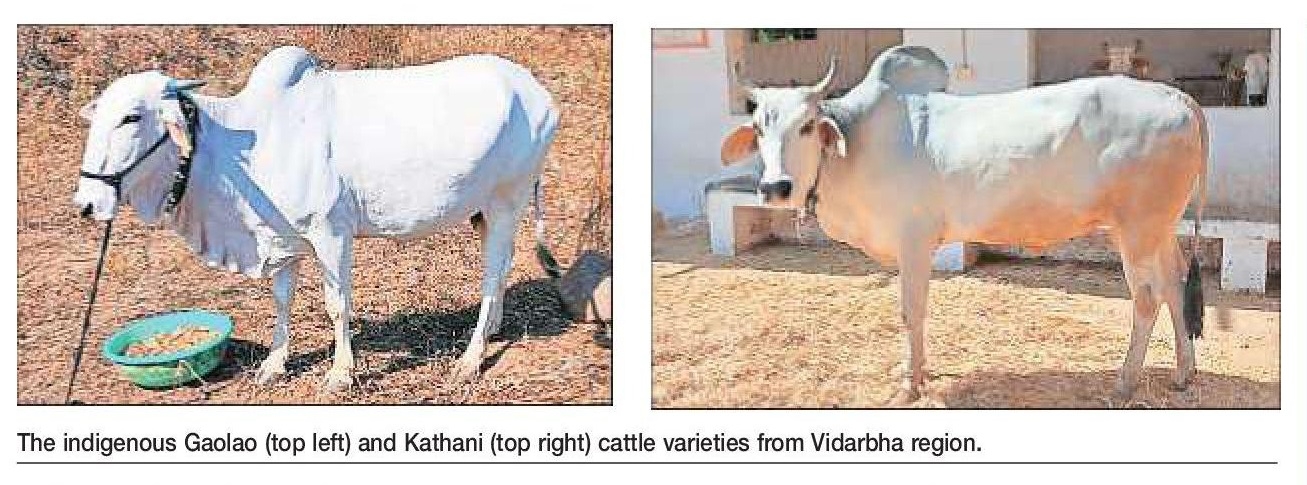
Vidarbha is home to ‘Gaolao’ and ‘Kathani’, two of Maharashtra’s seven recognised indigenous cattle breeds. Under the Centre’s Mission Zero Non-Descript, MAFSU is documenting ‘Khamgaon’, ‘Umrada’, ‘Melaghati’ and ‘Varhadi’ cattle.
The work is being carried out under the leadership of Dr Niteen V Patil, Vice-Chancellor, MAFSU, and the guidance of Dr N V Kurkure, Director of Research, with scientific documentation led by Dr S V Kuralkar and Dr Pravin Bankar, Associate Professor, College of Veterinary and Animal Sciences (COVAS), Akola.
“Today many of these animals are sold simply as ‘desi’. Once scientifically classified, they can command better prices while enabling genetic improvement through the selection of superior bulls and cows without compromising their natural resilience,”
Dr Bankar said.
Beyond milk—a rural livelihood
Unlike high-yielding Jersey cattle, indigenous breeds thrive on poor-quality fodder, tolerate heat, endemic diseases and drought-like conditions. Shrinking pasture lands and rising feed costs have further enhanced their relevance for small farmers. Though Jerseys produce significantly more milk, native cattle yield higher-fat, often more aromatic milk under natural ‘pawana’ grass-grazing. Researchers said many indigenous cows continue to provide one to two litres of milk daily, with some yielding four to five litres despite minimal inputs. “I own two Gaolao cows and they have never become a burden. My family drinks their milk every day and we sell the surplus. They survive on fodder available on our farm, unlike crossbred cattle that require expensive feed,” said Rahul Mahalle, a farmer from Parseoni taluka. Beyond milk production, indigenous cattle continue to sustain rural livelihoods. Despite nearly a 30 per cent decline in the use of bullock pairs since 2012 due to mechanisation, they remain indispensable for marginal farmers. Farmyard manure fetches Rs 1,000-1,500 per tractor trolley, while festivals such as Pola sustain occupations linked to cattle care and traditional craftsmanship.