India rejects IWT‘award’ by ‘illegal’Court of Arbitration
| Date :01-Sep-2026 |
NEW DELHI :
INDIA on Monday rejected the
Permanent Court of Arbitration’s
order setting aside its decision
to suspend the Indus Waters
Treaty with Pakistan, saying the
“illegally-constituted” body has
no jurisdiction to comment on
New Delhi’s sovereign decisions.
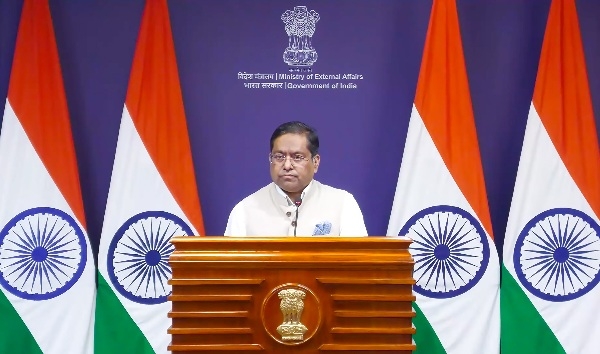
The Ministry of External Affairs
(MEA) said India’s decision to hold
the Indus Waters Treaty (IWT) in
abeyance remains in force.
New Delhi decided to put the
IWT in abeyance as part of a
series of punitive diplomatic and
economic measures unveiled
soon after the Pahalgam terror
attack in April last year that killed
26 civilians.
India has never recognised the
“existence in law of this illegally-constituted and so-called
Court of Arbitration”, and has
always said the “very establishment of this alleged arbitral body
constitutes a grave violation of
the IndusWatersTreaty”, the MEA
said in a statement.
Pakistan had approached the
Permanent Court of Arbitration
in The Hague in March this year
to determine the status of the
treaty virtually challenging
India’s action.
“Today, the illegally constituted so-called Court of
Arbitration (CoA) has issued
what it termed as an award concerning Interim Measures and
Status of the Indus Waters Treaty.
This so called Court was constituted by the World Bank in
patent breach of the terms of
the Treaty and India categorically rejects its so-called award,
just as it has firmly rejected all
prior pronouncements by this
illegally constituted body,” the
MEA said. “Accordingly, India
has never appeared before this
body and has refused to take
any cognisance of its earlier
pronouncements,” it said.
The MEA said the Court of
Arbitration has “no jurisdiction whatsoever to pronounce
on India’s sovereign decisions.”
“Its pronouncements, now
or in the future, will have no
effect on India’s actions in connection with the projects being
undertaken by India,” it said.
In the last few months, India
has stepped up work on several hydropower projects in
J&K that Pakistan had opposed
under the provisions of the pact
signed in 1960.