City girl brings back traditional connection with clay, natural colours this Ganeshotsav
| Date :10-Sep-2026 |
By Ashish Rajput :
WHAT if your Ganpati idol could
return to the earth not as waste,
but as a plant? In a city where
festival celebrations often leave
behind discarded idols and artificial materials, Priyanka of
Ganjipura is offering devotees a
different way to celebrate Ganesh
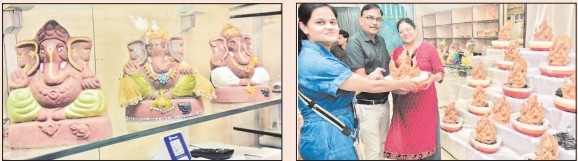
Chaturthi. She has created a
unique range of eco-friendly
Ganpati idols made from pure
clay, natural geru and traditional
materials, idols that can eventually find a new life as greenery in the very homes where they
were worshipped.
Originally from Jabalpur but
having spent years in Mumbai
and Dubai, Priyanka has created a unique range of eco-friendly Ganpati idols made from pure
clay, natural geru and other traditional materials. Her idea is
simple yet meaningful, an idol
that is worshipped with devotion during the festival can eventually become a plant and continue to be a part of the family.
Priyanka’s journey to making
Ganpati idols began after the
COVID-19 pandemic. Before
returning to Jabalpur, she worked
as a Visual Merchandiser with
corporate companies in Dubai
and Mumbai. She holds a PostGraduate Diploma in Apparel
Production and Merchandising
Management from Pune, and
had built a professional career
in the corporate sector.
However, the pandemic
prompted her to rethink her priorities. She eventually returned
to her native place Jabalpur and
began exploring her interest in
traditional and natural materials. She started making idols at
her ancestral shop, Mirror
House, in Ganjipura, turning a
family space into the starting
point of a new creative journey.
For Priyanka, the choice of
clay is deliberate. Her idols are
made from pure clay and finished
with geru, an earthy red colour
associated with traditional
Indian homes.
“The idea is to bring back the
traditional connection with clay
and natural colours,” Priyanka
said while talking to The
Hitavada.
She recalls the traditional practice of applying geru
to the entrances of homes and
has incorporated the symbolism into her idols.
But what makes her concept
particularly distinctive is what
happens after the festival.Her eco-friendly Ganpati sets come
with a pot, soil, manure and seeds.
Instead of becoming waste after
immersion, the clay idol can be placed
in the pot, allowing devotees to nurture a plant at home. The concept gives
a new meaning to visarjan - the idol
eventually returns to the earth and
becomes part of new life.
Priyanka also creates colourful
Ganesha idols using natural, claybased colours rather than relying
heavily on artificial colours. She
believes that keeping the materials
natural helps preserve the traditional character and spiritual
essence of the idol.
Another distinctive creation in her
collection is the Panchgavya
Ganesha, made using cow dung,
cow urine, ghee, curd and milk.
These idols are designed for
permanent placement in home
temples and are traditionally regarded as auspicious.
Today, Priyanka is a homemaker,
but her creative work has become
an important part of her life.
She credits her husband, Subhanshu
Swamy, a banker and resident
of Napier Town, for supporting
her endeavour.
Her journey, from the corporate
world of Mumbai and Dubai to working with clay in a traditional shop in
Ganjipura, is also a story of returning to one’s roots.
Through her work, Priyanka hopes
to encourage families to look beyond
artificial materials and rediscover
the beauty of natural celebrations.
For her, Ganesh Chaturthi is not
merely about bringing Bappa home.
It is about bringing home faith, preserving tradition and giving nature
a place in the celebration.
And perhaps that is the most beautiful part of her idea, when the festival ends, Ganpati does not simply
disappear. He returns to the soil, and
from that soil, something new begins
to grow.