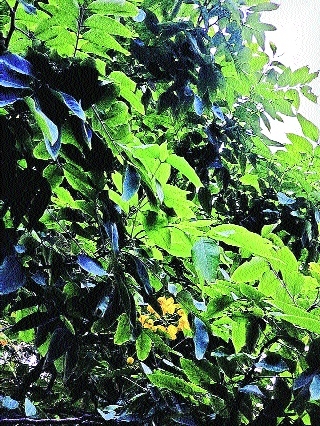
A splash of yellow: Why is an Amaltas tree in Nagpur blooming out of season?
Date :16-Sep-2026
Staff Reporter :
The yellow flowers of an Amaltas (Cassia fistula) tree are usually a familiar sign of summer giving way to the monsoon. But one tree in Nagpur has appeared to lose track of the calendar, has begun flowering in September instead of during its usual April-to-June flowering season. The tree was brought from Pachmarhi by Tahera Moiz Mannan, a resident of Mahdibagh Colony, around 15 years ago and has continued to grow despite the city’s hot and relatively dry conditions.
The prolonged heat experienced across Vidarbha this summer, coupled with comparatively lower moisture during the monsoon, could have played a role in this off-season flowering, Botanist Dr Alka Chaturvedi, explaining the phenomenon, said.
“When the temperature becomes higher and humidity comes down, the plant can be forced to go for flowering and fruiting. It assumes that it is reaching the end of its life and starts preparing for the next generation.” she elaborated, “If a particular tree has always been flowering in September, then it can continue to flower in September. But that is not the case here,” she said.
Dr Chaturvedi described this as a form of stress-induced or ‘forced’ flowering. “In gardening also, if you want a lot of flowering, you expose the plant to very high sunlight for a long time, which forces the plant to flower,” she said.
That does not necessarily mean the tree is unable to survive Nagpur’s climate. Amaltas can still be found growing in the wild and is commonly planted along roadsides.
The more telling problem, Chaturvedi said, may be what happens after the flowers and fruit appear. “Although it is flowering and fruiting, the number of seedlings and saplings is very low. That is because this is not the ideal climate for it,” she said.
Dr Chaturvedi also pointed to ‘Palash’, another flowering tree, as an example of how temperature and urban conditions can alter flowering patterns.
“Palash is considered a harbinger of spring. Because of warmer summers, flowering in plants near urban areas can happen as early as December and January, but generally, it happens later, around March,” she said.
Still, treating the single Amaltas tree as proof of climate change would be incorrect. “If we see that all or a majority of the Amaltas trees in Nagpur are flowering, then we could say that it is climate change,” she said. “In this case, other factors including the tree’s individual growing conditions, exposure to sunlight and the nutrients it receives are also important
to consider.”.
That leaves the September bloom somewhere between warning sign and botanical oddity. One tree flowering out of season cannot establish a citywide climate trend. But it does offer a glimpse into how plants can respond when temperature, moisture, and other environmental cues begin shifting.