Cabinet approves Rs 41,000crore development package
| Date :02-Sep-2026 |
Staff Reporter :
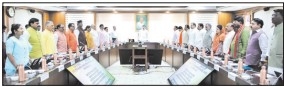
THE Madhya Pradesh Cabinet,
chaired by Chief Minister Dr
Mohan Yadav, approved financial proposals and welfare measures worth more than Rs 41,000
crore at a meeting held at the State
Secretariat on Tuesday. The decisions cover rural employment,
road connectivity, higher education, dairy development,
healthcare and administrative
expansion across the State.
Rs 29,619 crore rural scheme
cleared:The Cabinet ratified the
implementation of the Viksit
Bharat (Rural) VB-G RAM-G
Viksit Bharat Scheme in Madhya
Pradesh with an estimated financial outlay of Rs 29,619 crore. The
scheme will be effective from
July 1, 2026, with Rs 3,183 crore
estimated to be spent during
2026-27 and Rs 26,436 crore proposed for continuation from
2026-27 to 2030-31.
Under the scheme, eligible
adult members of rural households will receive a statutory
guarantee of 125 days of wage
employment in every financial
year, up from the existing 100
days. The Centre and state will
share expenditure in a 60:40 ratio,
with the state’s share estimated
at Rs 10,574 crore over five years.
The state will separately bear Rs
946 crore towards administrative expenditure.
Digital planning for rural
development: The scheme will
focus on developing rural infrastructure in line with the Viksit
Bharat@2047 vision. Every gram
panchayat will prepare a Viksit
Gram Panchayat Plan using GIS
technology, PM Gati Shakti layers and digital public infrastructure. These plans will be
integrated through a digital portal into the Viksit Bharat National
Rural Infrastructure Stack.
A dedicated State-level project management unit will also
be established under the Madhya
Pradesh State Rural Employment
Guarantee Council to support
technical work related to water
security, climate-resilient engineering, data science and modern livelihood models.
Rs 2,973 crore dairy plan
approved: The Cabinet
approved a Rs 2,973-crore dairy
development plan aimed at
strengthening the co-operative dairy system and upgrading the Sanchi brand. The plan,
developed with the National
Dairy Development Board, will
be implemented over five
years.
The Government plans to
expand co-operative milk societies from 7,331 villages to
26,000 villages. Daily milk procurement is targeted to rise
from 12 lakh kg to 52 lakh kg,
while processing capacity is
expected to increase from 17.8
lakh litres to 63.3 lakh litres a
day. Daily packaged milk sales
are projected to rise from seven lakh litres to 35 lakh litres,
while artificial insemination
coverage is proposed to
increase from 15% to 50%.
West Bhopal bypass gets
approval: The Cabinet granted revised administrative
approval for construction of a
35.61-km four-lane West
Bhopal Bypass with paved
shoulders under the Hybrid
Annuity Model. The total project financial cost has been
approved at Rs 3,225.51 crore,
while Rs 548.29 crore will be
spent on pre-construction
activities.
The bypass is expected to
provide a direct route for traffic between Jabalpur and
Narmadapuram and Indore,
allowing vehicles to bypass
Bhopal and reducing the travel distance by about 21 km.
The project alignment was
revised following the declaration of the Ratapani Tiger
Reserve, environmental
restrictions concerning the
Upper Lake catchment, the
presence of the ancient Shiv
Temple at Samsgarh and plans
to connect the bypass with the
eastern bypass.
Mehlua-Bina road gets Rs
3,272 crore: Administrative
approval was also granted for
the 67.116-km Mehlua-BinaKhimlasa-Malthone four-lane
road with paved shoulders
under the Hybrid Annuity
Model. The total project financial cost has been approved at
Rs 2,776.83 crore, along with
Rs 428.94 crore for pre-construction activities and Rs 65.77
crore for supervision charges.
The proposed route will
begin at Mehlua crossing on
NH-346, pass through Bina and
connect with NH-44 at
Malthone. The road is expected to improve regional, interstate and industrial connectivity, particularly around Bina,
where the BPCL refinery, thermal power plant, railway yard
and other major industries
generate substantial heavyvehicle traffic.
Three new technology universities: The Cabinet
approved the restructuring of
Rajiv Gandhi Proudyogiki
Vishwavidyalaya (RGPV) and
the establishment of three separate technology and skill universities in Bhopal, Ujjain and
Jabalpur.
The existing Bhopal university will be reorganised as
Madhya Bharat Technology
and Skill University, while the
autonomous engineering colleges in Ujjain and Jabalpur
will be developed as Malwa
Technology and Skill University
and Mahakaushal Technology
and Skill University respectively.
At present, RGPV has 13 programmes, 585 affiliated institutions and more than 3.83
lakh students. Technical institutions across the state will be
divided among the three universities on a divisional basis.
Separate legislation will be
enacted for the functioning of
the three institutions.
Healthcare maintenance
gets Rs 1,404 crore: The
Cabinet approved Rs 488.41
crore for continued maintenance and repair of medical
equipment in government
healthcare institutions from
April 1, 2026, to March 31, 2031.
A further Rs 915.77 crore was
approved for maintenance of
departmental assets in medical institutions during the
same period. The programme
will cover repair and maintenance of facilities including
modular kitchens and modular operation theatres.
New district offices get staff:
The Cabinet approved 21 positions for running district offices
of the Social Justice and
Disabled Persons
Empowerment Department in
the newly created districts of
Maihar, Mauganj and
Pandhurna.
The approval includes 15
regular positions and six outsourced Class-IV personnel
across the three districts. It also
approved creation of 20 posts
for district Ayush offices in
Niwari, Mauganj, Pandhurna
and Maihar.
Moong procurement limit
raised:The Cabinet ratified the
decision to increase the procurement limit for summer
moong from registered farmers from 25% to 60% of their
produce under the Price
Support Scheme.
The decision applies to the
procurement of moong and
urad from July 1, 2026, during
the 2026-27 marketing year.
The move follows the earlier
Cabinet decision of February
24, 2026, which had limited
procurement of summer
moong from registered farmers to 25% of their produce.