City lakes have a hidden health check: Aquatic insects
| Date :02-Sep-2026 |
By Simran Shrivastava :
Nagpur’s lakes may look different on the surface, but their tiny aquatic insects are quietly telling the story of their health. From water striders at Futala to dragonfly larvae at Gorewada, these often-overlooked creatures respond to changes in water quality, oxygen levels and habitat. Entomologist and Shivaji Science College Professor Dr Sharyu V Ghonmode Fulzele says studying these insects can reveal pollution and ecological changes that a single water sample may miss. “Aquatic insects and other aquatic macroinvertebrates can act as living indicators of lake health,” she said.
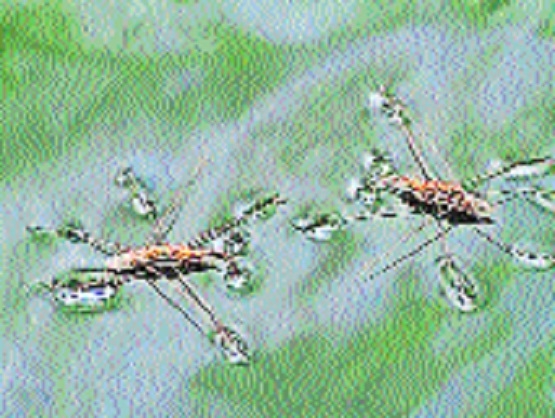
At Futala, presence of water striders such as Aquarius Paludum, Trepobates Taylori and Microvelia Douglasi shows that the lake still supports life at its water surface, while Micronecta Scholtzi and the backswimmer Notonecta Indica occupy the water below.
The dragonfly Anax junius’ young develops underwater before emerging as adults.
Together, these insects indicate a lake with several different aquatic habitats rather than a water body supporting only one type of insect life. Ambazari tells a more troubled story. Its insect community includes the same water-surface bugs, aquatic beetles, Anax junius and mosquito larvae, but their habitat is increasingly shaped by the lake’s water hyacinth growth and sewage related nutrient loading.
Dr Ghonmode said the problem goes beyond
what is visible as green growth on the surface. Sewage adds organic matter to the water, increasing oxygen demand, while excess nutrients encourage weeds and algae.
As oxygen conditions change, insects requiring cleaner, well-oxygenated water become vulnerable. That is why, she said, presence of insects alone cannot be taken as a sign of a healthy lake.
Mayflies, stoneflies and many caddisflies are sensitive to pollution and generally require oxygen-rich water.
Their disappearance would be a warning.
Chironomid Larvae, including the familiar red bloodworm forms, can survive much poorer conditions; if pollution-tolerant insects begin dominating while sensitive species disappear, it points towards organic pollution and low oxygen. At Gandhisagar, the backswimmer Notonecta Indica occurs alongside water-surface bugs, beetles and mosquito larvae. The significance lies in the variety of life occupying different parts of the lake.
Dr Ghonmode said a healthy aquatic community is not defined by having the greatest number of insects, but by supporting different species with different environmental requirements. A community gradually reduced to a few tolerant insects would indicate that the lake is losing ecological diversity.
Gorewada presents another combination, with water striders, aquatic bugs, beetles, Notonecta indica and the dragonfly Anax junius. The dragonfly is particularly tied to the lake because its larval stage is spent underwater. Its presence therefore depends on suitable aquatic conditions as well as the vegetation and habitat around the water.
The lake edge, Dr Ghonmode pointed out, is as important as the water itself. Shallow areas, mud, natural vegetation and emergent plants provide spaces where aquatic insects feed, breed and eventually emerge.
When these margins are concretised or lost to encroachment, an insect loses not just a patch of greenery but part of the habitat needed to complete its life cycle.
That makes the changing edges of Lendi Talao, the fluctuating water conditions at Sonegaon and Sakkardara, and the dense aquatic growth at Ambazari relevant to Nagpur’s insects.
Different pressures may produce different problems, but all of them alter the habitats available to aquatic life.