Country’s largest solar ecosystemtaking shape in city: CM Fadnavis
| Date :21-Sep-2026 |
Business Reporter :
HIGHLIGHTING rapid transformation of the region’s industrial landscape, Chief Minister
Devendra Fadnavis on Sunday
said that the country’s largest
solar module ecosystem is currently being developed in
Nagpur. Envisioning Nagpur as
a major hub for solar energy
over the next decade, he urged
entrepreneurs and investors to
make large-scale investments in
the sector.
The Chief Minister made these
remarks during a visit to Avaada
Group’s facility in the Additional
Butibori Industrial Area, where
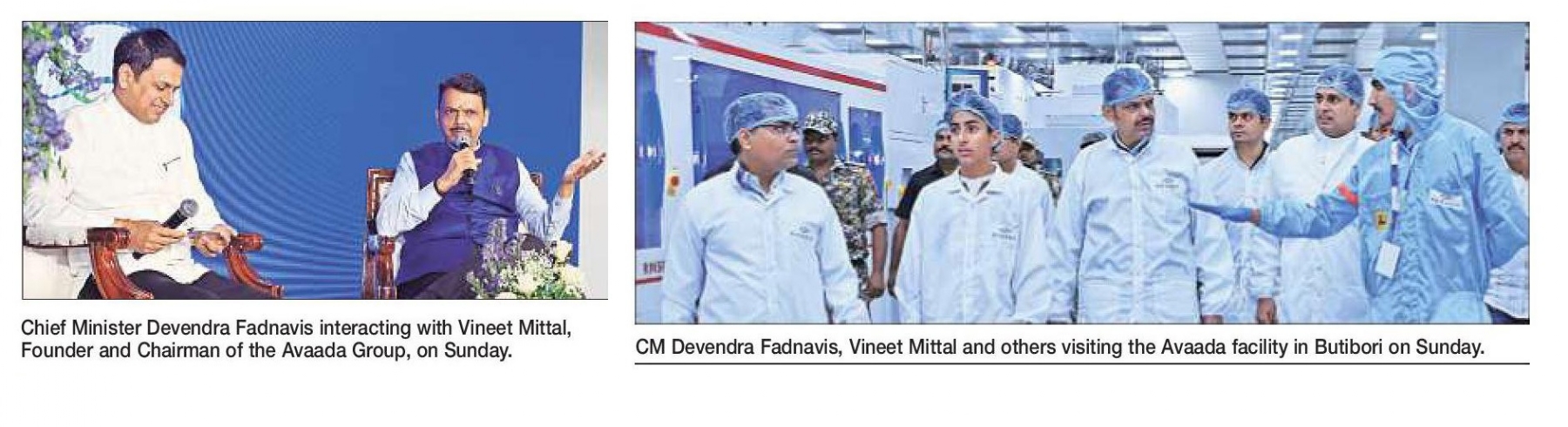
he inspected solar module manufacturing unit and held an interactive session with the company officials. During the event,
Vineet Mittal, Founder and
Chairman of the Avaada Group,
hosted an exclusive interactive
dialogue with the Chief Minister,
covering topics such as State
infrastructure, industrial development, and the future urban
evolution of Mumbai. Speaking
on the ambitious New Nagpur
project, Fadnavis said that an
ecosystem tailored for smart
industries is actively being built.
Over 50 per cent of the land
required for the project has
already been acquired, creating
strong momentum for fresh investment.
Recognising that the country’s pioneering solar module project is taking shape in the Additional Butibori region, he announced allocation of an additional 250 acres of land requested by the Avaada Group for its facility expansion. He further disclosed that since the acquired land in the current Additional Butibori area is fully utilised, the Government is planning a third phase (Additional Butibori-III) alongside ongoing land acquisition for a new industrial zone in the neighbouring Wardha district.
Praising Avaada as a flagship leader in solar manufacturing, Fadnavis highlighted that advanced integration technologies are enabling high-efficiency smart module production. He noted that the facility was completed at remarkable speed following its groundbreaking ceremony and currently employs 5,000 workers.
Vineet Mittal, Chairman, Avaada Group said, “The conversation offered an interesting opportunity to look beyond the usual policy discussion and understand the practical dimensions of building businesses and enabling investment at scale.
Maharashtra has the opportunity to combine its industrial strengths with its growing clean-energy ambitions. At Avaada, we are building capabilities across the solar value chain, focusing on progressively increasing integration across modules and cells and planning expansion into ingots and wafers. Our Butibori facility is an important part of this roadmap and reflects our focus on strengthening domestic supply chains and contributing to India’s journey towards greater energy self-reliance.”
Avaada Electro, the solar PV manufacturing arm of Avaada Group, currently operates 8.5 GW of N-Type TOPCon glass-to-glass module manufacturing capacity across its Nagpur and Dadri facilities. The company plans to add another 5.1 GW, taking its total module manufacturing capacity to 13.6 GW.
It has operational 3 GW of N-Type TOPCon solar cell manufacturing capacity at Butibori. Another 3 GW is in an advanced commissioning stage and is expected to become operational in the quarter ending September 30, 2026. The facility uses N-Type TOPCon technology and can deliver cell efficiencies of up to 25.5% under standard test conditions.
The manufacturing lines feature 16-busbar and 18-busbar architectures. The company is also progressing toward establishing an additional 6 GW solar cell manufacturing facility in Greater Noida, which would bring its overall solar cell manufacturing capacity to 12 GW. As part of its backward integration strategy, Avaada Electro is also planning 3 GW of ingot and wafer manufacturing capacity at Nagpur.
The integrated manufacturing approach aims to strengthen supply-chain resilience, reduce logistics costs, and increase domestic value addition, supporting India’s broader objective of building self-reliant clean-energy manufacturing capabilities.
Avaada providing jobs to 5,000;
Mahindra to start in 5 months’
■ Staff Reporter
CHIEF Minister Devendra
Fadnavis on
Saturday said
Nagpur has
been fast
emerging as a
major hub for
r e n e w a b l e
energy and
advanced manufacturing and
would emerge as the country’s
largest solar ecosystem.
Interacting with the mediapersons during his visit to the
Avaada facility in Nagpur,
Fadnavis said the bhoomipujan of the project was performed in 2024 and the facility is now operational, providing employment to around
5,000 workers.
Fadnavis pointed out that,
“The facility, which is involved
in manufacture of advanced
solar modules, would play an
important role in strengthening India’s manufacturing capabilities and enabling the country to move ahead in global
competition. The focus, he said, was not merely on solar module production but on creating a comprehensive solar manufacturing ecosystem.” Fadnavis informed the media that the State Government was actively facilitating investments by making land available and expediting necessary permissions.
He said around 1,000 acres of land was allotted to Mahindra group for its proposed project, and work was expected to commence within the next four to five months. The Chief Minister said arrival of major industrial projects would also lead to development of ancillary industries and create additional employment opportunities. Nagpur and wider Vidarbha region, he said, had considerable potential to become an important destination for large-scale industrial investments.
The State is also working on strengthening logistics infrastructure to support industrialisation. Plans are being pursued to develop freight connectivity linking important industrial centres in Vidarbha, including Wardha and Gadchiroli, with other parts of Maharashtra such as Nashik and Jalna. Such connectivity is expected to facilitate movement of raw materials and finished products and provide a major boost to industries.
Fadnavis said the Government was creating an ecosystem conducive to industrial investment by focusing on land availability, permissions, infrastructure, logistics and technology. Expansion of advanced manufacturing facilities, coupled with improved connectivity, would strengthen Nagpur’s position as an important industrial and clean-energy hub, he added.
Replying to a question regarding Congress leader and MP Rahul Gandhi, Fadnavis remarked, “Considering the kind of mimicry Rahul Gandhi does, I sometimes feel he
would be better suited to a career as a stand-up comedian. After all, if his politics has left his party struggling for employment, perhaps stand-up comedy could give him a new profession.”
Digital transaction paves way to
industrial growth
When asked about petrolpump owners insistence of not accepting digital payment over Rs 2,000, Chief Minister Devendra Fadnavis said, “A narrative is being set by some sections of the society against the decision which is not good. In fact, I would attribute the credit of industrial growth of our country to UPI and digital transaction. The Government is simultaneously taking steps to make business and payment systems more transparent and efficient.