Submerged Chola port cityyields fresh secrets, throws uptorpedo jar during exploration
| Date :24-Sep-2026 |
CHENNAI :
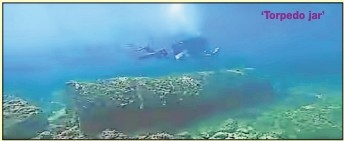
THE submerged Chola port city yielded fresh secrets throwing up a “torpedo jar” during an underwater exploration at Poompuhar, an official said
on Wednesday.
This major breakthrough for maritime archaeology came during the 18-
day underwater exploration at
Poompuhar about 260 km from here.
This third phase of deep-sea underwater excavations off the Poompuhar
coast wrapped up on Tuesday,
unearthing critical physical evidence
of the submerged Chola port city of
Kaveripoompattinam.
Located at the mouth of the Cauvery
river, Poompuhar is also known as
Kaveripoompattinam and it once
served as the maritime hub of early
Chola kingdom. Catastrophic floods
lashed the coast and swallowed major
portions of the city around 4th to 5th
century CE. The expedition carried out
by the Tamil Nadu State Department
of Archaeology (TNSDA) in collaboration with the Indian Maritime
University, spanned a two-square-kilometre underwater zone.
The findings offered compelling new
insights into ancient Tamil Nadu’s
global trade networks and changing
coastal landscape.
Among the
most significant discoveries of
the 2026 campaign is a fineceramic fragment of a West
Asian “torpedo jar,” with an
estimated total diameter of 30
cm to 35 cm. Historically
utilised to transport liquid cargo such as wine and olive oil
across oceanic trade routes,
the vessel directly reinforces
literary accounts of
Poompuhar’s thriving maritime links with West Asia and
the Mediterranean world, an
official said. Divers also discovered four massive terracotta ring wells, measuring 60 cm
to 65 cm in diameter, resting
on the sea floor.
Since the ring wells were traditionally constructed on dry
land to access freshwater,
researchers noted that their
presence on the seabed strongly points to a buried
palaeochannel - an ancient
riverbed that was eventually
swallowed by the sea due to
coastal erosion and rising water
levels. The expedition yielded
a massive pottery haul of over
250 ceramic pieces, including
rare glazed ware fragments.
Unlike earlier isolated underwater surveys conducted in the
1990s, the multi-phase 2025-
26 project utilised state-of-theart marine technology including side-scan sonars, sub-bottom profilers, multibeam
scanners, and Remotely
Operated Vehicles (ROVs) to
map the ocean floor.