DJ noise pollution NHRC seeks report within 2 weeks
| Date :03-Sep-2026 |
Staff Reporter :
The Commission has sought details of the permissible decibel limits for sound systems. It has also asked whether a permission or licensing system exists for their use
The National Human Rights Commission (NHRC) has taken cognizance of a complaint regarding unchecked noise pollution during Sarvajanik Ganeshotsav celebrations in Maharashtra. The NHRC
has directed the Maharashtra Pollution Control Board (MPCB) to submit an Action Taken Report (ATR) within two weeks in
this regard.
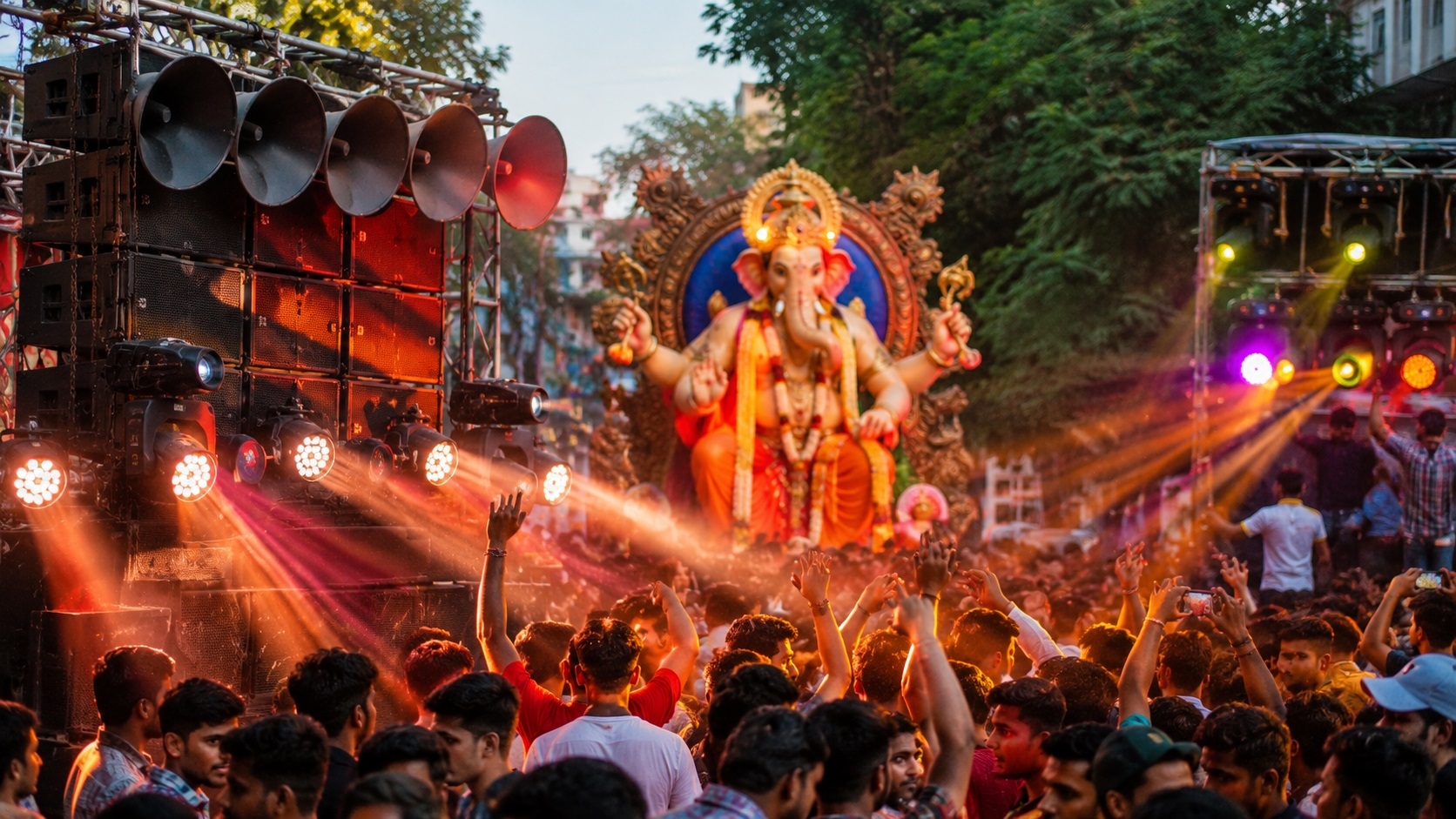
The complaint focused on the use of powerful sound amplifiers and DJ systems by Ganesh mandals. It alleges that large sound systems are installed outside pandals and are often operated beyond the permitted 10 pm deadline. The complaint also raises concerns over loud music during Ganesh immersion processions. It alleges that high-intensity sound and vibrations cause problems to pregnant women, infants, patients and senior citizens. The complainant has also raised concerns over the use of laser lights during the celebrations. It was alleged that such lights can cause serious harm to people, including possible damage to eyesight.
The NHRC, headed by Member Priyank Kanoongo, has directed the MPCB to inquire into the allegations and submit its report.
The Commission has sought details of the permissible decibel limits for sound systems. It has also asked whether a permission or licensing system exists for their use. The MPCB has been asked to provide details of the number of permissions issued during the last one year. It has also been asked to state which authority is competent to grant such permission.
The Commission has further sought details of enforcement action taken during the last one year. This includes challans, prohibition orders, notices and other action against those violating noise limits.
Ganeshotsav music beats
decibel limit in Nagpur
The issue is important for Nagpur as around 1,500 sarvajanik Ganesh mandals installed idols in the city during Ganeshotsav 2025.
Under the Noise Pollution Rules, the permissible noise limit in residential areas is 55 decibels (dB) during the day and 45 dB at night. In commercial areas, the limit is 65 dB during the day and 55 dB at night. In silence zones, the limits are 50 dB during the day and 40 dB at night.
The daytime period is from 6 am to 10 pm. For loudspeakers used at public places, the sound level at the boundary should not exceed 10 dB above the prescribed standard or 75 dB, whichever is
lower. Written permission is
also required for using
loudspeakers.
Noise pollution during Ganeshotsav has remained a concern in Nagpur for several years. In Nagpur, MPCB has recorded sound levels above the permissible limits since 2019. An official said that readings at five monitoring locations were found between 64.7 dB to 82.9 dB on different
days in 2024.
The Nagpur Bench of the Bombay High Court has also directed authorities to carry out real-time noise monitoring near Ganesh pandals. It directed that the readings be displayed. The court has also said that sound systems can be seized if violations are found. Despite this, enforcement continues to be a challenge. The Nagpur police had warned Ganeshotsav mandals against using Djs in 2025.
However, no action was taken against any mandals despite massive use of DJs during processions in city. In 2024, Sadar police had registered a case
against a DJ operator for allegedly playing loud music without permission after midnight.
Meanwhile, former MLC Sandip Joshi has also raised the issue. In a message, he said several religious festivals are scheduled in the coming months. Citizens, particularly senior citizens, patients and children, face difficulties due to high sound levels and laser lights during such celebrations.
Joshi said there was no
opposition to celebrating festivals with happiness and enthusiasm.
However, he suggested promoting traditional instruments such as bands and dhol-tasha, along with bhajans, instead of excessive DJ sound. He said such traditional forms could provide a new platform for cultural celebrations. He also informed that a digital petition was being registered to seek restrictions on excessive sound and laser lights during religious festivals.