OVERSHOOT, Earth has lost its chance to prevent global warming’s harms: UN report
| Date :03-Sep-2026 |
WASHINGTON :
IN A strategic retreat in the fight
against climate change, the United
Nations has acknowledged that
Earth has lost its chance to prevent
some of the worst of global warming’s harms. So now the world must
figure out how to get temperatures
below the danger zone and back to
safety, officials say.
Earth is soon going to exceed the
safe temperature threshold agreed
upon by the world in the 2015 Paris
climate accord because of warming
from the burning of coal, oil and gas,
according to a bleak first-of-its-kind
report issued by the United Nations
Environment Programme on
Wednesday.
So instead of preventing warming of 1.5 degrees, now the UN said
it wants policymakers to “prepare
for and navigate a future” in which
the globe crosses that limit and then
corrects course and
cools temperatures.
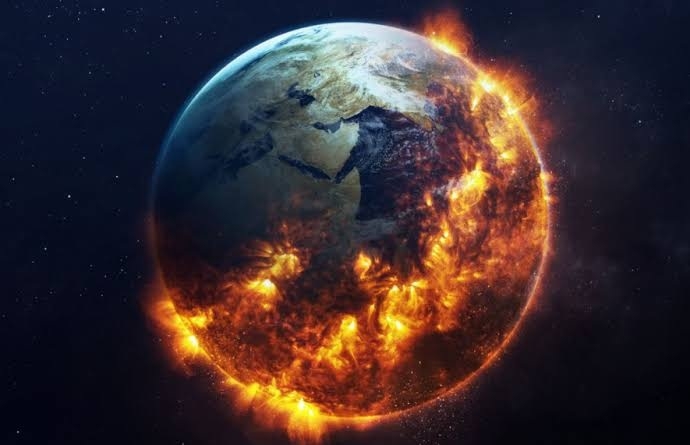
The report envisions
that global temperatures will pass
1.5 “within the next few years,” follow a hump-shaped path of more
warming, peak, then gradually cool
to below the 1.5 mark, ideally by the
end of the century. The report and
experts call it “overshoot.”
Instead of giving up, scientists
and UN officials recommend trying
to limit excessive warming and then
bring the temperature back down
to the agreed-upon threshold. But
it still will mean decades of increased
weather-related disasters, rising
seas, extinctions and melting ice
and glaciers.
“Humanity is speeding past the limit to
avoid climate catastrophe,” United
Nations Secretary-General Antonio
Guterres said.
After a period of over-the-limit
warming, the new strategy envisions
getting back below the limit by ending fossil fuel use and developing
some kind of way to suck industries’ carbon dioxide out of the
air.
“It’s a reality check. We have
to live with this warmer world,”
said report co-author Richard
Betts, a climate scientist at the
University of Exeter. “But there’s
still a lot we can do to limit
warming.”
After the Paris climate
accord, the United Nations
ordered its climate science arm
to study different warming limits.
A goal of 1.5 degrees Celsius
(2.7 degrees Fahrenheit) above
mid-19th century temperatures became generally accepted after the scientists found
dramatic impacts that affect
people and the planet at 2
degrees Celsius (3.8 degrees
Fahrenheit) but not at 1.5
degrees. The world is now at
1.4 degrees Celsius (2.5 degrees
Fahrenheit) above pre-industrial levels, some scientists have
calculated. The measure is
based on a 20-year average,
rather than a single year’s temperatures.
Despite experts saying there’s
no way to limit warming to 1.5
degrees, UN officials long
maintained the 1.5 window was
still open. Wednesday’s report
finally admitted that the world
will cross the 1.5 threshold “in
the next few years.”
The report said the most
optimistic scenario has warming peaking at 1.8 degrees (3.2
degrees Fahrenheit) around
mid-century if countries pursue ambitious climate goals,
but that governments’ current
policies should push temperatures to 2.6 degrees (4.7
degrees Fahrenheit) above preindustrial levels by 2100.
“Let’s be very clear, 1.5 target is still the goal. But now we
need to approach it differently from above,” said UNEP
Executive Director Inger
Andersen.
The 1.5 limit is not “some
magical climate cliff” where it’s
just game over, said University
of Victoria climate scientist
Andrew Weaver, who wasn’t
part of the study. “Every tenth
of a degree we avoid still means
less damage.”
It’s most important to first
limit the new peak temperature
and then reduce the amount
of time above 1.5 degrees,
Andersen said. But the world
likely will be in that overshoot
period for “many, many
decades,” Betts said.