City adopting new face patterns of Maa Durga
| Date :30-Sep-2026 |
By Saniya Chakraborty :
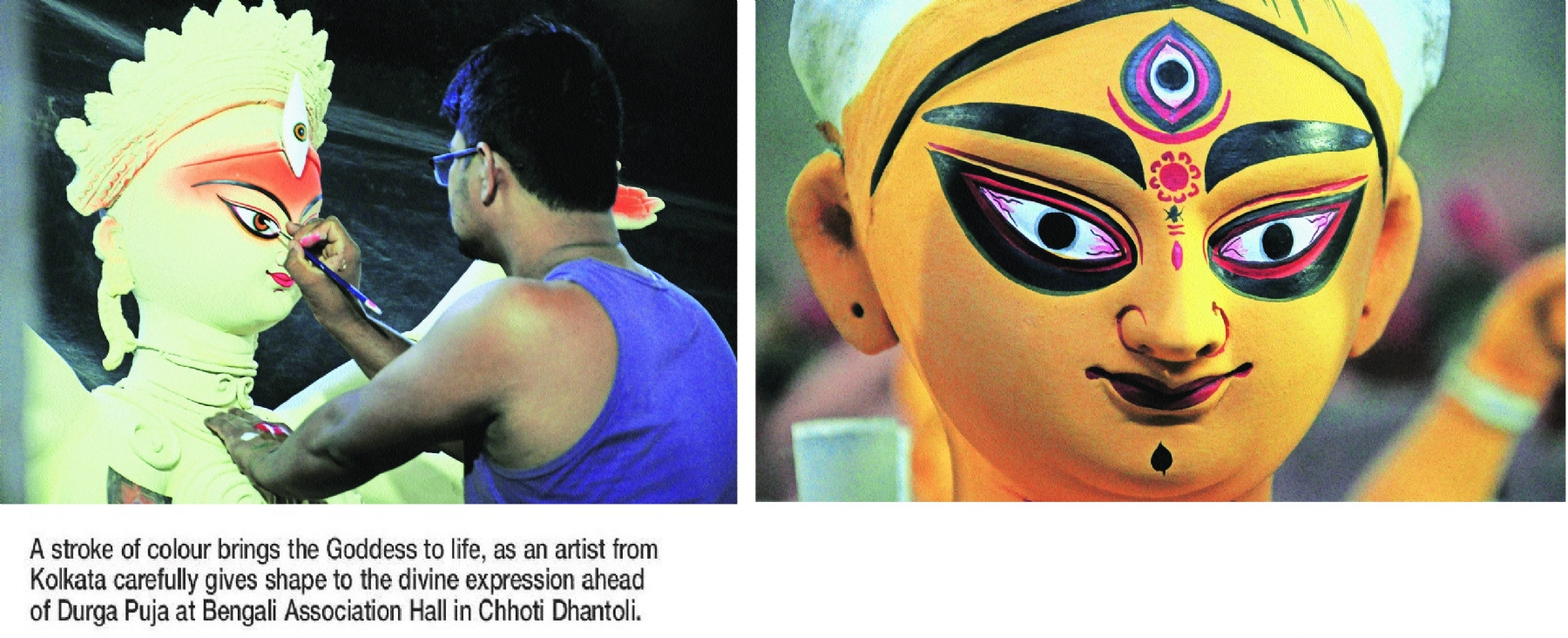
Before the drums rise and the city begins to glow in festive lights, there is a quiet moment - when clay acquires a face, and a pair of eyes turns an idol into ‘Maa Durga’. The curve of an eyebrow, the sweep of an eye, the softness of the lips and the strength in the jaw can change not just how the Goddess looks, but how she feels.
In Nagpur, where Durga idols emerge across neighbourhood during Navratri, the face of the Goddess has quietly evolved over the last three decades. The most striking change is in the eyes, but the transformation extends to almost every facial detail, from the forehead, eyebrows to the nose, lips, cheeks and jawline.
According to artisan Subhash Pal, who comes to Nagpur from Krishnanagar in Kolkata and is second-generation in idol-making, the face has its own language.
“The eyes are the most important and sensitive part.
They give the idol its expression and make the face come alive,” he shared.
Working through the traditional clay-modelling process, they closely see how preferences for Durga’s face have changed over the years. Earlier, idols commonly featured round faces, softer cheeks, gently curved eyebrows and comparatively calm eyes, giving Maa Durga a serene and motherly appearance.
Today, sharper facial contours are increasingly visible. The eyes are often elongated and more prominently outlined, while raised eyebrows can give the Goddess a powerful, warrior-like gaze. Different artistic influences have also found space in Nagpur.
Traditional Bengali and Bonedi-style (time-honoured heritage style) features co-exist with Kolkata and Kumartuli-inspired faces, while local artisans have developed their own interpretations. Some idols retain a soft, compassionate expression; others have sharper noses, sculpted cheekbones, defined lips and stronger jawlines that create a more dramatic appearance.
For an artisan, however, facial proportions cannot be treated separately. The forehead determines the placement of eyebrows;
the eyebrows influence the eyes; the eyes alter the expression; and even the shape of the lips can change the perceived emotion.
The growing influence of photographs and social media has also made styles more accessible. Organisers can now show artisans a particular face or eye design and request a similar expression. Yet every idol remains slightly different.
And when the final strokes are made around those eyes,
the transformation is complete - clay becomes a face, the face acquires a gaze, and for thousands across Nagpur, Maa Durga seems to have arrived and
the first gaze makes the Goddess feel alive.