More men than women seek help at RMH suicide prevention clinic
| Date :04-Sep-2026 |

Staff Reporter :
1,443 persons with suspected suicidal tendency recorded in 4 years
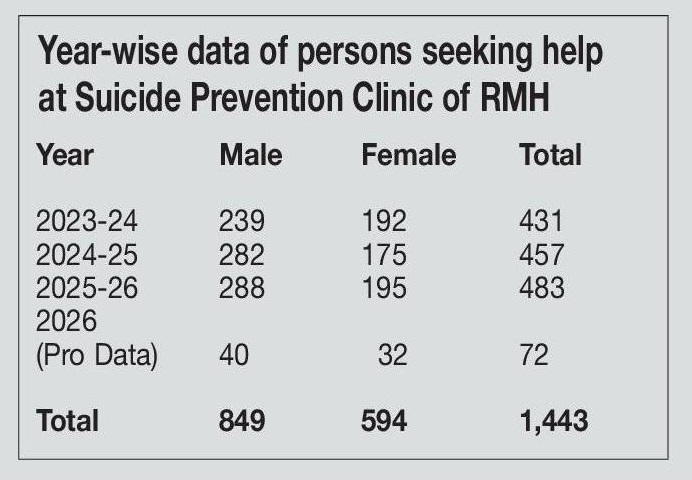
More men than women have sought help at the Suicide Prevention Clinic at Regional Mental Hospital (RMH), Nagpur, over the past four years, with 849 men among the 1,443 patients registered during the period. Women accounted for the remaining 594 patients.
The year-wise figures show that the difference has remained fairly consistent. In 2023-24, the clinic received 431 patients, including 239 men and 192 women. The number increased to 457 in 2024-25, with 282 men and 175 women, and to 483 in 2025-26, comprising 288 men and 195 women. Provisional figures for 2026 show 72 patients, so far, including 40 men and 32 women.
The figures reflect a broader gender pattern in suicide.
Dr Deepak Awchat, Class-I Psychiatrist at Regional Mental Hospital (RMH), explained
that many men are conditioned to believe that they have to
be strong, independent and capable of handling problems on their own.
Psychologist Arpana Yadav added that, from childhood, expressions such as ‘mard ko dard nahi hota’ may sound like social clichés, but when repeatedly reinforced, they can make emotional vulnerability feel unacceptable.
“That conditioning can make emotional distress harder to discuss at home or with friends,” she said. She added that, often, depression is irritated by the inability to share or express one’s problems, which can lead to suicidal tendencies.
Dr Awchat noted that suicidal behaviour is shaped by several factors rather than by any one particular reason. Coping mechanisms, problem-solving abilities, willingness to seek help, social support, personality, and access to resources can all influence whether suicidal thoughts progress further.
810 patients recover from suicidal thoughts
As many as 810 of the 1,443 patients who approached the Suicide Prevention Clinic at Regional Mental Hospital (RMH), Nagpur, over the past four years have recovered from suicidal thoughts, according to clinic data. The clinic’s figures indicate that a substantial number of people who reached out for professional intervention were able to move out of suicidal thinking. This underlines the importance of having an accessible service where people can seek help without judgement.