‘Corroded tank components led to Godhni chlorine leak’
| Date :06-Sep-2026 |
Staff Reporter :
“The chlorine gas leak at Maharashtra Jeevan Pradhikaran (MJP) Water Treatment Plant (WTP) at Godhni on August 24 was caused by corrosion in a component of the chlorine storage system,” informed Kumar Ashirwad, District Collector, on Saturday while addressing a press conference at Collector office.
Ashirwad said the six-member committee constituted by the District Disaster Management Authority had identified significant deficiencies in chlorine storage and safety arrangements at the plant.
“The material of the storage
tank component had corroded, resulting in chlorine gas leak,” Ashirwad said. He added that the inquiry had highlighted concerns regarding the manner in which hazardous chlorine cylinders were being stored at the facility. The leak, which occurred shortly after midnight on August 24, originated from a reserve 900-kg chlorine cylinder at the 4.5 MLD water treatment plant, triggering panic in nearby residential areas and leading to several residents being hospitalised.
The Collector said the inquiry committee found that chlorine storage arrangements at the plant did not conform to the level of safety expected for a hazardous gas installation located close to populated areas.
He noted that such cylinders should ideally be housed in underground facilities or self-contained enclosed rooms designed to minimise risk in the event of a leak. Instead, the storage arrangement at the Godhni plant left the system vulnerable. Soon after the incident, Ashirwad had ordered a detailed investigation under provisions of the Disaster Management Act, 2005. The committee comprised representatives from the Maharashtra Pollution Control Board, Nagpur Municipal Corporation’s Public Health Engineering Department and Fire Department, Nagpur Rural Administration, the National Disaster Response Force (NDRF) and the Directorate of Industrial Safety and Health. The panel examined equipment condition, maintenance records, storage practices, emergency response systems and actions taken during the incident. Ashirwad said the report would now be forwarded to the State Government as the MJP facility falls under its jurisdiction. “The issue of accountability will be addressed and action will be taken against those found responsible,” he said. The inquiry was also tasked with identifying technical, human and administrative shortcomings and recommending measures to prevent similar incidents. These include strengthening safety protocols, improving storage infrastructure, enhancing emergency preparedness and conducting regular inspections and training.
Biogas leakage triggers panic near Tipu Sultan Sq, timely action averts tragedy
Staff Reporter
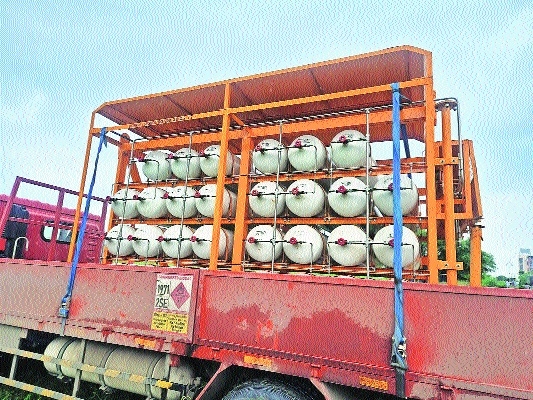
A major hazard was averted on Saturday afternoon after a commercial vehicle transporting biogas cylinders reported severe gas leakage along Kalamna Road, near Tipu Sultan Chowk and Cancer Hospital. The emergency call was logged at 2.29 pm, prompting Sugat Nagar Fire Station to dispatch two emergency response vehicles. Fire personnel, led by In-charge Station Officer Sunil M Dokre and Lead Fireman Kapil R Parve, reached the spot within 10 minutes. The vehicle
Tata Eicher 1612 (MH-40 DC 6114) driven by Prashant Dudhiraj Shende and managed by Vikas Singade belongs to SUSBDE India Company, Bhandewadi. The leakage stemmed from a ruptured pipe connection linked to the biogas cylinders. As a precautionary measure, the vehicle was immediately guided to an open, isolated ground where 30 cylinders containing approximately 600 kg of biogas were safely depressurised. According to the management, the incident resulted in an estimated loss of Rs 60,000 in lost gas, while the vehicle and cylinder equipment worth Rs 32 lakh were successfully saved. Following safety clearance, Yashodharanagar Police (led by PSI Datta Gete) took custody of the vehicle for further formal proceedings. No injuries or fire outbreaks were reported.