Potency Of Bija Mantras
| Date :06-Sep-2026 |
By DR BHUSHAN KUMAR UPADHYAYA :
In Yogic and Tantric traditions,
sound is treated not only as a
means of communication but a
potent force to elevate consciousness and transform personality.
Amongst the most sacred sounds
mentioned in the above traditions,
Bija or seed Mantras occupy great
significance. Bija Mantras are considered highly condensed sound
vibrations believed to contain subtle energy forms associated with a
particular principle of nature and
human consciousness.
Classic Yogic and Tantric texts
talk of many Bija Mantras like Hrim,
Klim, OM, Lam, Vam, Ram, Yam,
Ham, etc. These Bija Mantras have
no dictionary meaning. Their significance lies in their special
sounds , vibrations, associations,
and visualisation.
Yoga has attached great importance to Mantras. Mantra chanting
is treated as a very powerful technique to make the mind one pointed or Ekagra. Chanting provides a
stable anchor to the mind and
stops its wandering hither and
thither. Patanjala Yoga Sutras
describe the chanting of Pranava or
OM as a great doorway to inner
calm and awareness.
Tantric traditions expand the
principle more extensively. In
Tantric traditions, Shabda or sound
and consciousness are treated as
intimately related. The concept of
Nada Brahma occupies a dominant
position in the spiritual thought
process. The entire cosmos is
believed to have originated from
the primordial sound. This sound is
vibrating constantly in the universe.
Hence , it is easy for consciousness to elevate with the help
of sound vibrations.
Bija Mantras have no explicit
meaning. So the mind does not get
engaged in analysis and conceptual interpretations. The mind just
experiences the sound and gets
absorbed into essence and bliss.
Modern neuroscience gives very
interesting parallels to these Yogic
insights. Neuroscientific research
has found that rhythmic chanting
of sound has a deep impact on the
entire nervous system. It reduces
the Default Mode Network of the
brain which is associated with self
referential thinking and anxiety.
Mantra repetition strengthens the
memory and attention centres of
the brain as the mind becomes
focused and concentrated.
Awareness is centred around the
sound.
This leads to better emotional regulation and cognitive processing. It has been found that
repeated chanting of Mantras stabilizes breath and there is better
autonomic regulation. Vocalisation
with slow breath has positive
impacts on respiratory patterns and
cardiovascular dynamics.
Measurable changes are noticed in
the heart rate variability. Om
chanting experiences are widely
recorded in such scientific studies.
Reduced activity is noticed in the
region of the limbic system particularly the amygdala which is the
centre of fear and stress.Breath
awareness coupled with visualisation and chanting of Bija Mantras
helps in sustained attention.
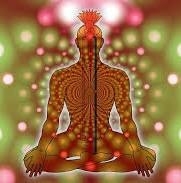
In the scheme of Chakra awakening practices, these Bija Mantras
are considered a very powerful tool
to elevate consciousness.
Each
Chakra has a specific Bija Mantra
like Muladhara (Lam),
Swadhidthana (Vam), Manipura
(Ram), Anahat (Yam), Vishuddhi
(Ham), Ajna (Om), Sahasrara (no
sound - transcendence). Chanting
of these Bija Mantras is believed to
activate the concerned Chakra. The
five elements are also said to be
associated with the first five Bija
Mantras- Lam (earth), Vam (water),
Ram (Agni), Yam (air), Ham (ether).
Apart from the ritualistic nature
of these Bija Mantras, their rhythmic chanting is highly elevating
and leads to a deeper state of
meditation.

(The writer is Former DG Police
& CG, Homeguards,
Maharashtra) ■