Eyesight Damaged In Surgery
| Date :07-Sep-2026 |
By Adv. R. S. Agrawal :
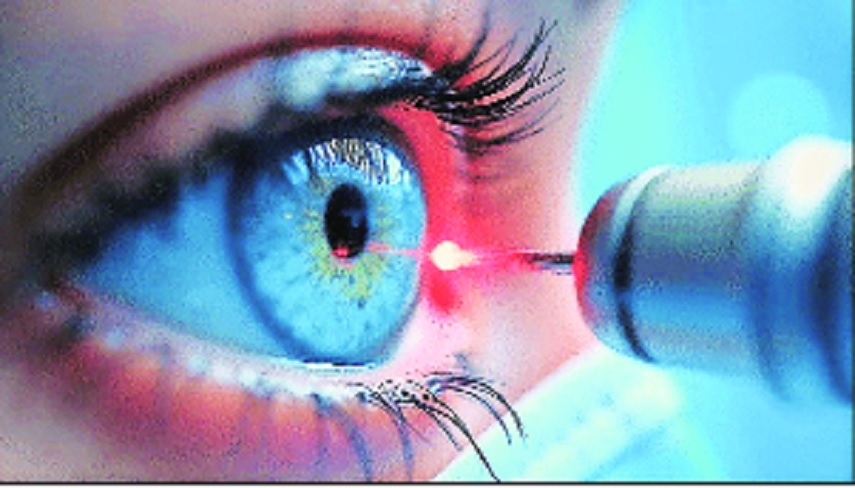
Director of the Regional Institute of Opthalmology, Kolkata had admitted that the unfortunate incident with regard to serious complications in the eye sight of several patients who had undergone surgery was either due to
contamination and presence of
micro-organisms in the operative devices or in the solutions or for a faulty method of sterilisation of the instruments.
.
IN THE judgement of the case- Gobinda Chandra Debnath v. The State of West Bengal and others, delivered on September 2, 2026, Ms Justice Sampa Sarkar and Justice Arjun Ray Mukherjee have held at the Calcutta High Court, State strictly liable in the event of eye sight getting damaged during Surgery.
By the order passed on July 24, 2025 and impugned here in this appeal, the Single Judge recorded that the Director of the Regional Institute of Opthalmology, Kolkata had admitted that the unfortunate incident with regard to serious complications in the eye sight of several patients who had undergone surgery at the Gardenreach SDH/SSH, Metiaburz (Nadia Hospital) South 24-Parganas,
was either due to contamination and presence of micro-organisms in the operative devices or in
the solutions or for a faulty
method of sterilisation of the instruments.
However, the Lady Single Judge directed that the writ Petitioner should approach the appropriate forum seeking compensation /damages. This led to filing of this appeal.
Advocate for the appellant submitted that compensation to the victim compensation is a part of the constitutional frame-work. State does not enjoy any immunity. For acts of medical negligence during the course of treatment of citizens at Government hospitals. State is bound by the principle of strict liability. It was submitted that the constitutional court in exercise of power micro-organisms under Article 226 of the Constitution of India, can direct compensation to be paid on account of such gross negligence by the instrumentalities of the State.
The HC is quite firm on its conclusion that the liability of the State cannot be avoided. The Union Ministry of Health and Family Welfare has implemented several programmes for promotion of eye health and prevention of visual impairment.
The State Government had also adopted similar schemes. Undoubtedly right to eye sight flows from the right to life guaranteed under Article 21 of the Constitution of India.
The appellant is an electrician by profession. He is self-employed and the sole earning member of his family. He availed of the treatment at a Government hospital. Apart from the appellant, other similar victims suffered the same fate. The cataract surgery led to complications, infections and series of treatments.
The Director, RIO, MCH, Campus opined that the unfortunate incident took place due to contamination of micro-organisms in the operative devices or in the solutions/fluids and /or for faulty method of sterilisation
of the instruments. Contemporaneous documents annexed to the writ petition indicate the extensive treatment which the appellant had to undergo. It follows that ‘a claim in public law for compensation’ for contravention of human rights and fundamental freedoms, the protection of which is guaranteed in the Constitution, is an acknowledged remedy for enforcement and protection of such rights and such a claim based on strict liability made by resorting to a constitutional remedy provided for the enforcement of a fundamental right is ‘distinct from, and in addition to, the remedy in private law for damages for the tort’ resulting from the contravention of the fundamental right.
The defence of sovereign immunity being inapplicable, and alien to the concept of guarantee of fundamental rights, there can be no question of such a defence being available in the constitutional remedy.
It is this principle, which justifies award of monetary compensation for contravention of fundamental rights, guaranteed by the Constitution, when that is the only practicable mode of redress available for contravention made by the State or its servants in the purported exercise of their powers and enforcement of fundamental right is claimed by resort to the remedy in public law under the Constitution by recourse to Articles 32 and 226 of the Constitution. This is what was indicated in Rudul Sah (1983 ) 4 SCC 141 and is the basis of the subsequent decisions in which compensation was awarded under Articles 32 and 226 of the Constitution for contravention of fundamental rights.
The HC has concurred with the view that the Court is not helpless and wide powers given to this Court by Article 32, Court, which itself is a fundamental right, imposes constitutional obligation on this Court to forge such new tools, which may be necessary for doing complete justice and enforcing fundamental rights guaranteed in the Constitution, which enable the award of monetary compensation in appropriate cases, where that is the only mode of redress available.
The power available to this Court under Article 142 is also an enabling provision.
The contrary view, would not merely render the Court powerless and constitutional guarantee mirage, but may, in certain situations, be an incentive to extinguish life, if for extreme contravention the Court is powerless to grant any relief against the State, except by punishment of the wrongdoer for the resulting offence, and recovery of damages under private law, by the ordinary process.
If the guarantee that deprivation of life and personal liberty cannot be made except in accordance with law, is to be real, the enforcement of the right in case of every contravention must also possible in the Constitutional scheme, the mode of redress being that which is appropriate in the facts of each case. This remedy in public law must be most readily available when invoked by the have-nots, who are not possessed of the wherewithal for enforcement of their rights in private law, even though its exercise is to be tempered by judicial restraint to avoid circumvention of private law remedies where more appropriate.
This indicates the principle on which the court’s power under Articles 32 and 226 of the Constitution is exercise to award monetary compensation for contravention of a fundamental right. The present case is on the finding reached, it is a clear case for award of compensation to the petitioner for the custodial death of her son. In the case-Achutrao Haribhau Khodwa v. State of Maharashtra-(1996)2 SCC 634, the Supreme Court has observed that running a hospital was not in exercise of the State’s sovereign power as such, the State was vicariously liable in tort for the tortuous acts committed by its servants.
The High Court has allowed the appeal and set aside the impugned order to the extent of relegating the appellant to an appropriate forum. The Calcutta High Court has also ordered compensation to the tune of Rs five Lakh to be paid to the appellant under the special circumstances within eight (8) weeks.