‘Be the change if you want to see better India’
| Date :19-Oct-2019 |
Business Bureau
A public health researcher and neurologist working in remote areas in Gadchiroli district, Dr Yogesh Kalkonde on Friday said improving health of rural people was main goal in his life.
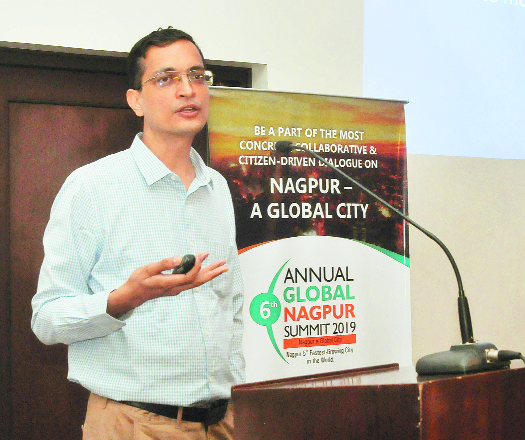
“Nobody had invited me to come to Gadchiroli. I decided to come here on my own because I believe that if you want to see a better India by bringing about change - be the change,” he said. He was speaking at the ‘Global Leadership Talk’ held here on the topic ‘In search of mission and meaning’. The event was organised by the Nagpur First. Recipient of ‘Welcome Trust / DBT Fellowship’ and the ‘Bruce Shoenberg International Award’ in Neuroepidemiology, was sharing his journey and transition from the cutting edge research world in the USA to Gadchiroli, a red-corridor Indian district consistently faring among the 250 districts with lowest GDP. Kalkonde further said that many people often focus on the path rather than focusing on the ultimate goal. “Normally we take easy path and proceed our life’s journey. However after spending 60-70 years, we realise that we are heading nowhere. It happens with those who are not goal centric,” he said while explaining why he came back to India setting aside his bright career.
“I do not know how many people in these remote areas have been benefiting because of my services but the job is certainly giving meaning to my life,” he said. Kalkonde is a neurologist, a specialized area in medical field that needs modern equipment to treat the patients. Obviously, these facilities are not there in the small health care centres in Gadchiroli where Kalkonde is working right now.
“About eight years back when I had decided to work in the remote areas, the specialisation (Neurologist) was coming in between me and Gadchiroli. Then I realised that before becoming the neurologist, I have earned basic degrees in the medical field that could be helpful to the tribals,” he said saying education should empower one.
However, Kalkonde felt he had seen higher education pushing people towards ‘small compartments’. “You start treating only a particular type of patents despite of the fact that you can take care of many other illnesses,” he said to justify what he meant by ‘small compartments’. Kalkonde’s view on education are quite different from others. He outrightly rejected that learning is equal to education and education is equal to school. “One can learn things any where in this world. Moreover I believe that one does not need school to be creative,” added.
Commenting on his relationship with tribals, Kalkonde said he discovered humanity in them. He also called urbanisation a ‘big mistake’. “Initially when I started offering medical services, the tribals had shown some reluctance. But gradually it vanished and today we share a very strong bond of trust between us. Even a stranger (in villages) can offer you food. But you cannot imagine urban people behaving in such a fashion,” he pointing out the difference between urban and rural. Sachin Jahagirdar, Treasurer, of Nagpur First, conducted the proceeding
while Ankit Jha proposed the
vote of thanks.