ISCCM to focus on patient management to reduce their stay at hospital
| Date :17-Nov-2019 |
By Vikas Vaidya :
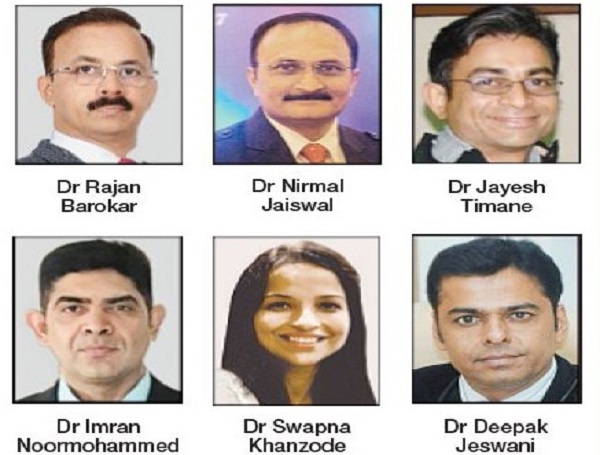
It is a general allegation that doctors make deliberate attempts to prolong hospital stay of the patients. But members and office-bearers of Indian Society for Critical Care Medicine (ISCCM) have thought in a different way. Using technology and advancement, these Critical Care specialists who have to be always on toes, work on a plan with focus on patient management to reduce his/her stay at a hospital. Dr Rajan Barokar, a well-known Critical Care Specialist, said, “When patient comes to us usually he/she is in a bad condition. We have to take every care, lot of investigations are conducted, medicines are given. Obviously, patients have to spend lot of money which cannot be avoided.
We gave a deep thought over it. Our conferences, Continuing Medical Education (CMEs) update us and then we came up with the solution. Now, we have focused our attention on patient management and we have succeeded in reducing the patients’ stay at hospital.” Dr Nirmal Jaiswal, President of Academy of Medical Sciences, said, “We have organised four workshops arranged -- Continuous Renal Replacement Therapy (CRRT), Advanced Mechanical Ventilation, Hémodynamic Monitoring and WinFocus( World Interactive Network Focussed on Critical Ultrasound).
They encompassed the technical advances in each of these fields. CRRT addressed hemodialysis in patients who are unstable and can’t undergo regular dialysis. Advanced ventilation is the improved use of Artificial Intelligence for mechanical breathing machine. Hémodynamic Monitoring covered better methods of monitoring vascular dynamics, which go long way in management of critical patients. WinFocus taught the emergency sonography to Intensivist , who can act quickly and make decision to save a life at point of care.
There are great advancement in the field of critical care; both in technology and robust data based evidence ; changing the scenario of intensive practice.” “But has it added to the already expensive ICU treatment? The answer is a clear NO. All the technology and knowledge is designed to save a life, improve the sick patient faster, reduce the days spent on ventilator, reduce the length of hospital stay and obviously reduce the overall cast of hospitalisation. One less day of ICU stay can save a lot of money depending on kind of drugs and /or supportive therapies.
So these updates will surely benefits medical fraternity and society equally,” stated Dr Jayesh Timane, President of ISCCM, Nagpur branch. Dr Imran Noormohammed, Secretary of ISCCM, Nagpur branch, commented, “Why monitoring is important during admission? A patient is vulnerable for organ damage during illness if proper monitoring is not done during that time. Patients with sepsis, trauma, etc are more likely to develop major complications if initial resuscitation is inadequate. The adequacy of resuscitation can be quantified with various monitoring modalities. These monitoring methods with recent advances is being discussed in this critical care update.” Dr Swapna Khanzode explained, “Main aim of critical care to anticipate problems and if you can prevent the complications then it is better. Haemodynamic monitoring helps you in knowing how far patient is going in for complications. Investigation of Lactate levels can give you better idea of patient’s condition.
You can anticipate on the basis of these levels. If the level is at higher side then patient’s Blood Pressure will fall because patients’ tissue oxidation is not well. You can start treating in that direction with a thought what measures can be taken to improve tissue oxidation. Advantage of such monitoring can prevent complications. For example, kidney blood flow compromised and other organs too get affected which we can stop. Whole outcome is such, patients morbidity of liver and kidney is reduced, ICU stay is reduced, patient’s hospital stay can be reduced to large extent.
Prolonged hospital stay can involve more organs which is a bad sign. In future in day to day life he or she can suffer, because in large quantity antibiotics are given. That can be avoided is what we are aiming.” Dr Deepak Jeswani, ex-President of ISCCM, elaborated, “Monitoring in ICCU patients has advanced in last 8-10 years. It involves Invasive blood pressure, heart, breathing, neuro monitoring and this is basically to detect problems early and to do early goal directed management and barring few very high tech monitoring which required high end monitoring rest are included in ICU management of patient and thus do not increase the cost of treatment. But it has shown to decrease the length of icu stay and studies have also shown to improve survival in these patients.”