@@INCLUDE-HTTPS-REDIRECT-METATAG@@
Narrow Gauge in Vid now becomes history as service on Itwari-Nagbhid route ceases
Narrow Gauge in Vid now becomes history as service on Itwari-Nagbhid route ceases
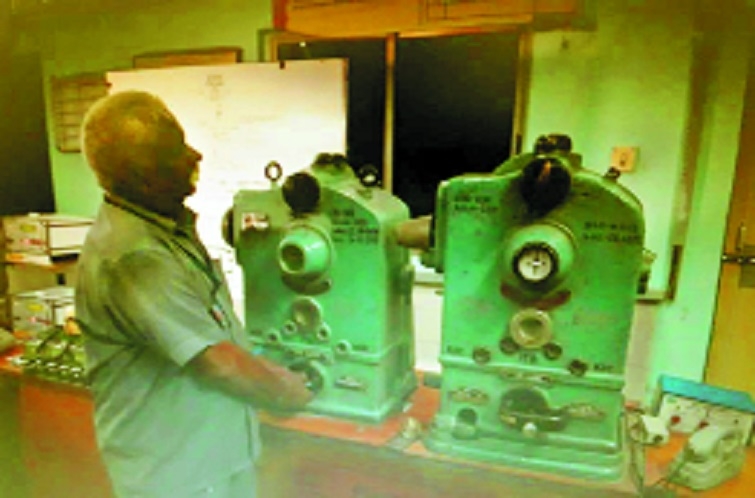
A staffer operating machine used for the Narrow Gauge.
Staff Reporter :
Last section of Narrow Gauge (NG) in Vidarbha would move to pages of history as the last service on Itwari-Nagbhid completed its run on Sunday night. The NG train was elegantly decked for its last run as Divisional Railway Manager (DRM), South East Central Railway, Nagpur Division, Shobhana Bandopadhyay, flagged off the train from Itwari railway station. Helper Virendra Kohle was given the honour of showing free flag to the last service of NG on the 110 km route of Itwari-Nagbhid that is being closed from November 25 to pave way for conversion to Broad Gauge.
Senior officers of division including Additional Divisional Railway Manager Y H Rathod, ADRM B K Rath and other branch officers were present for the ceremony. SECR’s Nagpur Division boasted of one of the highest density of NG network, about 622 kms, of which 300 km is now converted into BG. The Itwari-Nagbhid route has three stations en route Kuhi, Umrer and Bhiwapur and 13 passenger halts. NG network of Nagpur Division was part of Satpuda range in 20th century.
The service on Itwari-Nagbhid was started on November 9, 1909, and four services catered to small hamlets and villages. Daily nearly 3,400 travellers used to use NG train for commuting and ticket sales earned Rs 48,000 daily for division. With switching over to BG the travel would become faster as currently about four and half hour was required from Itwari to Nagbhid. Once the BG train services start then same distance could be completed within two and half hours. Moreover after BG and alternative rail route will be available on Ballarshah-Nagpur section. As per decision, the relics of NG would be conserved at heritage museum in city for people to see for themselves.
Many machines to become useless With closure of last of NG section, several of machines that facilitated smooth movement of trains would also become relics. One among them is a machine that facilitated exchange of rail token between two stations. A ring fitted with iron ball would be inserted in this machine and it was part of signalling system. The Loco Pilot would need to exchange the ball at next station and only after getting another one the train would move forward. These machines were fitted in Station Master’s room, one each for UP and DN line, respectively. The driver and Station Master exchanged the ball in perfect synchronisation.