NASA scientists map wind flow pattern on Mars, first for any planet: Study
| Date :14-Dec-2019 |
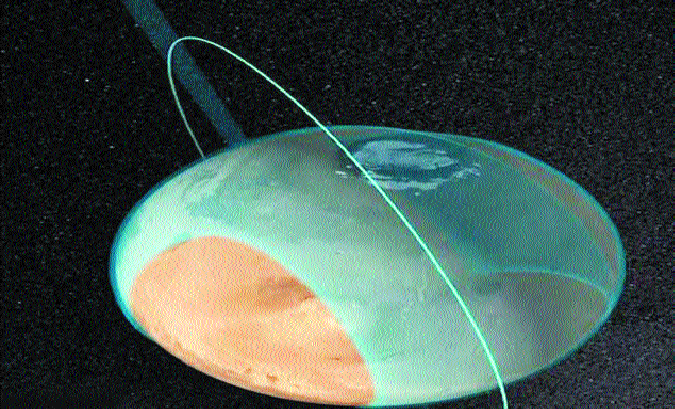
IN A first-of-its-kind study carried out on any planet, NASA scientists have mapped the global wind circulation patterns in the upper atmosphere of Mars -- 120 to 300 kilometers above the Red Planet’s surface.
The researchers, including those from the University of Maryland, Baltimore County (UMBC) in the US, reprogrammed probes aboard NASA’s Mars Atmosphere and Volatile EvolutioN (MAVEN) spacecraft to collect wind measurements on the Red Planet. The reprogramming allowed an instrument called the Natural Gas and Ion Mass Spectrometer (NGIMS) aboard MAVEN -- that was normally stationary -- to “swing back and forth like a windshield wiper fast enough,” the scientists said in a statement.
They added that this tweaking enabled them to gather data on the winds flowing across the Martian surface.
The study, published in the journal Science on Thursday, was based on data collected by MAVEN two days per month from 2016 to 2018. “It’s a clever re-engineering in flight of how to operate the spacecraft and the instrument,” said Mehdi Benna, study co-author from NASA Goddard Space Flight Center (GSFC) in the US. “And by doing both -- the spacecraft doing something it was not designed to, and the instrument doing something it was not designed to do -- we made the wind measurements possible,” Benna said. The researchers said the wind flow patterns observed in the Martian upper atmosphere matched what was predicted from theoretical models.
The study noted that the average circulation patterns from season to season were very stable on Mars. However, the scientists said the shorter-term variability of winds in the upper atmosphere was greater than anticipated.
“On Mars, the average circulation is steady, but if you take a snapshot at any given time, the winds are highly variable,” Benna said. The researchers said more work is needed to determine why these contrasting patterns exist.
Another insight gleaned from the study is that the wind hundreds of kilometers above the Red Planet’s surface still contained information about landscapes below such as its mountains, canyons, and basins.