Dr Corinna, German researcher studying roots of ancient temples in India
23 Dec 2019 10:37:11
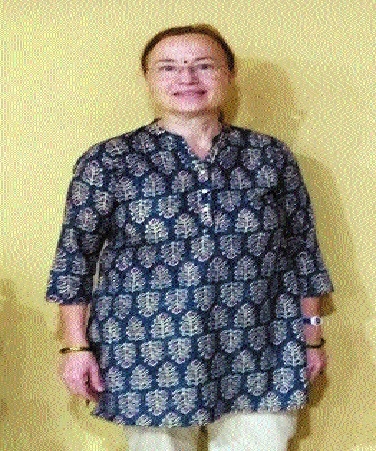
Dr Corinna Wessels Mevissen the world famous scholar of Indian Art History for the first time visited Nagpur to study Vakataka Dynasty
By Rajendra Diwe
“Studying Indian Art History, Archaeology and Indian Philosophy is my passion. I think that destiny has given me the task to conduct research in ancient Indian history and spread the information about rich cultural heritage of India,” said Dr Corinna Wessels Mevissen. Dr Corinna is German by birth and got interest in archaeology. She visited India for number of times and for the first time she came to Nagpur city to visit some ancient sites of Vakataka dynasty. Dr Corinna is instrumental in popularising the Devuni Gutta Temple found near dense forest near Kothur village, Mulugu mandal, Jayashankar Bhupalapally district of Telangana state. She conducted thorough research on this temple and published the paper in international journal. The research paper was very popular and Archeological Society of India took the cognizance and started renovation work at the site.
Dr Corinna highlighted, “Devuni Gutta temple is on a densely forested hill locally called ‘Devuni Gutta’. One has to walk from the village through a forest. This temple is very uncommon, unusual, unique and no comparison with any ancient temple. The temple is estimated to had built in 6th century CE.” Corinna Wessels-Mevissen, studied the History of Indian Art, General Art History, Indian Philology and Archaeology at the Free University Berlin and Christian-Albrechts-Universität zu Kiel, and passed her doctorate in the former subject at the Free University Berlin. She worked as a curator for South Asia, Asian Art Museum, Berlin. She made the photo and video documentation of the Devuni Gutta temple. She termed it as extremely interesting and said that it could turn out to be a discovery like no other.
The temple came in limelight after the visit of Dr Corinna who had found its resemblance with the world famous Angkor Wat temple. After her visit the State Archaeology and Archaeological Survey of India (ASI) visited the place to assess the potential and also take steps for the preservation of the temple. “Carved out on sandstone bricks, the sculptures of the temple offer a unique blend of styles visible in Udayagiri and Scandagiri of Odisha, a bit of Amaravati-like architecture,” she added. The carvings resemble a bit of Bouddham and Jainam, certainly an amalgam of several isms including Shaivism and Vaishnavism. The Lion and the Ardha Padma carved out on the pillar is similar to that of Aayaka stambham of Bouddha Stupam.
“The sculpture is amalgamation of the Shiva-Vaishanva sects of the Hindu religion,” she said and stressed on the need for the immediate protection and preservation of the temple. Dr Sheshayan Deshmukh of Vidarbha Sanshodhan Mandal invited Dr Corinna to Nagpur city to study some ancient temples near by city. He along with Dr Chandrashekhar Gupta took Dr Corinna to Ramtek and they visited to number of ancient structures of the temple surrounding Ramtek.
Dr Corinna mentioned, “I am really satisfied to witness the rich cultural heritage sites near Nagpur city. I have visited Kevala Narasimha temple, Rudra Narsimha temple and Kaalyavan temple in Ramtek. The structures also have resemblance with the Devuni Gutta temple. The inscription dates to 5th CE of Kevala Narsimha temple has been an epigraphic record of Vakataka dynasty. This visit will add new dimension to my research. It has also raised my interest to study the Vakataka dynasty in details.”