Maharashtra shows improvement in MMR, NMR
| Date :21-Jun-2019 |

By Vikas Vaidya:
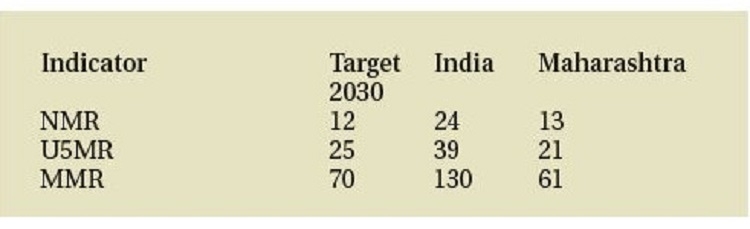
Against India’s Maternal Mortality Ratio (MMR) of 130, Maharashtra is 61; India’s Neonatal Mortality Rate (NMR) is 24 while Maharashtra stands at 13
State’s score is average in covering the population under PHC, Sub-centres and CHC where Uttar Pradesh, Gujarat score better
Maharashtra showed tremendous improvement in Maternal Mortality Ratio (MMR), Under-Five Mortality Rate (U5MR) and Neo-natal Mortality Rate (NMR). With all its efforts, State has brought down the MMR to 61, national ratio stands at 130, NMR at 13 as compared to national rate 24 and U5MR at 21 less than national average of 39. The target for 2030 was 70, 12 and 25 respectively. State achieved it in 2019 only. This is revealed in Economic Survey of Maharashtra that was released recently.
Dr Nandita Palshetkar, President of Federation of Gynaecological Societies of India (FOGSI), expressed happiness over MMR. She said, “FOGSI had taken initiative and it also attributed to the steps taken by this Maharashtra Government. All the gynaecological bodies and individual doctors contributed a lot which I must appreciate.” As far as rendering health services through its hospitals is concerned, State is average and not better than Gujarat and Uttar Pradesh. State has 10,638 sub-centres with average population covered per sub-centre is 5,786.
There are 1,823 Primary Health Centres (PHC) in State. A population of 33,766 is covered by one PHC. One Community Health Centre covers 1,70,515 population and there are 361 CHCs. Situation is not bad if the norms of Government are considered. As per government norms, a sub-centre is to be set up for a population of 3,000 in tribal areas and for a population of 5,000 in non-tribal rural areas. Similarly, a PHC for a population of 20,000 in tribal and for a population of 30,000 in non-tribal rural areas and a Community Health Centre (CHC) as referral centre for every four to five PHCs covering a population of 80,000 to 1.2 lakh is to be set up.
At present there are 2,057 Sub-centres, 315 PHC and 67 CHC covering 90 lakh tribal population in rural areas of the State. Public health aims to improve the quality of life through prevention and treatment of diseases, including mental health. ‘Ensure healthy lives and promote well-being for all at all ages’ is one of the Sustainable Development Goals (SDG). The Government is formulating and implementing various healthcare schemes and programmes to ensure accessible and affordable healthcare for all. Though the State has already achieved some of the targets set under SDGs related to health, sustained efforts are being made by the Government to maintain and improve the health indicators. State has created three-tier health infrastructure to provide comprehensive health services.
The primary tier comprises of Sub-centres, Primary Health Centres (PHC) and Community Health Centres (CHC). The sub-district hospitals and district hospitals constitute secondary tier whereas, well equipped medical colleges and super-speciality hospitals located in major cities are at tertiary level. Services provided by PHC are outdoor patients department (OPD), six beds indoor ward, emergency services, operative and laboratory facilities, implementation of various health programmes, family planning services and treatment of patients referred by sub-centres.
Community health centres, sub-district hospitals and district hospitals provide round the clock emergency health services. To cater need of medical professionals, a number of medical and paramedical institutions including Ayurveda, Yoga and Naturopathy, Unani, Siddha and Homeopathy viz. AYUSH institutions have been set up.
1.5 lakh doctors registered with MMC After getting the degree, the allopathy medical practitioners have to register to Maharashtra Medical Council, Mumbai and renew their license every five years. Upto March, 2019 in all 1,50,436 (of which 66,081 are post graduate) allopathy doctors have registered and 92,908 doctors have renewed their licenses. Based on the data of registered medical practitioners who have renewed their licences, estimated doctor population ratio is 1:1,330 in the State.
Health infrastructure of the State Government (As on March 31, 2019)
l Sub-centres - 10,668
l Primary Health Centres - 1,828
l Rural Hospitals (CHC) - 364
l Primary Health Units - 193
l Mobile Medical Units - 40
l Sub-district Hospitals - 91
l District Hospitals - 23
l Hospitals having Medical Colleges - 17
l General Hospitals - 8
l Women Hospitals - 13
l Mental Hospitals - 4
l Leprosy Hospitals - 4
l TB Hospitals - 4
l Other Hospitals (Orthopedic) - 1
l Regional Referral Hospitals - 2
(Source: Directorate of
Health Services, GoM)